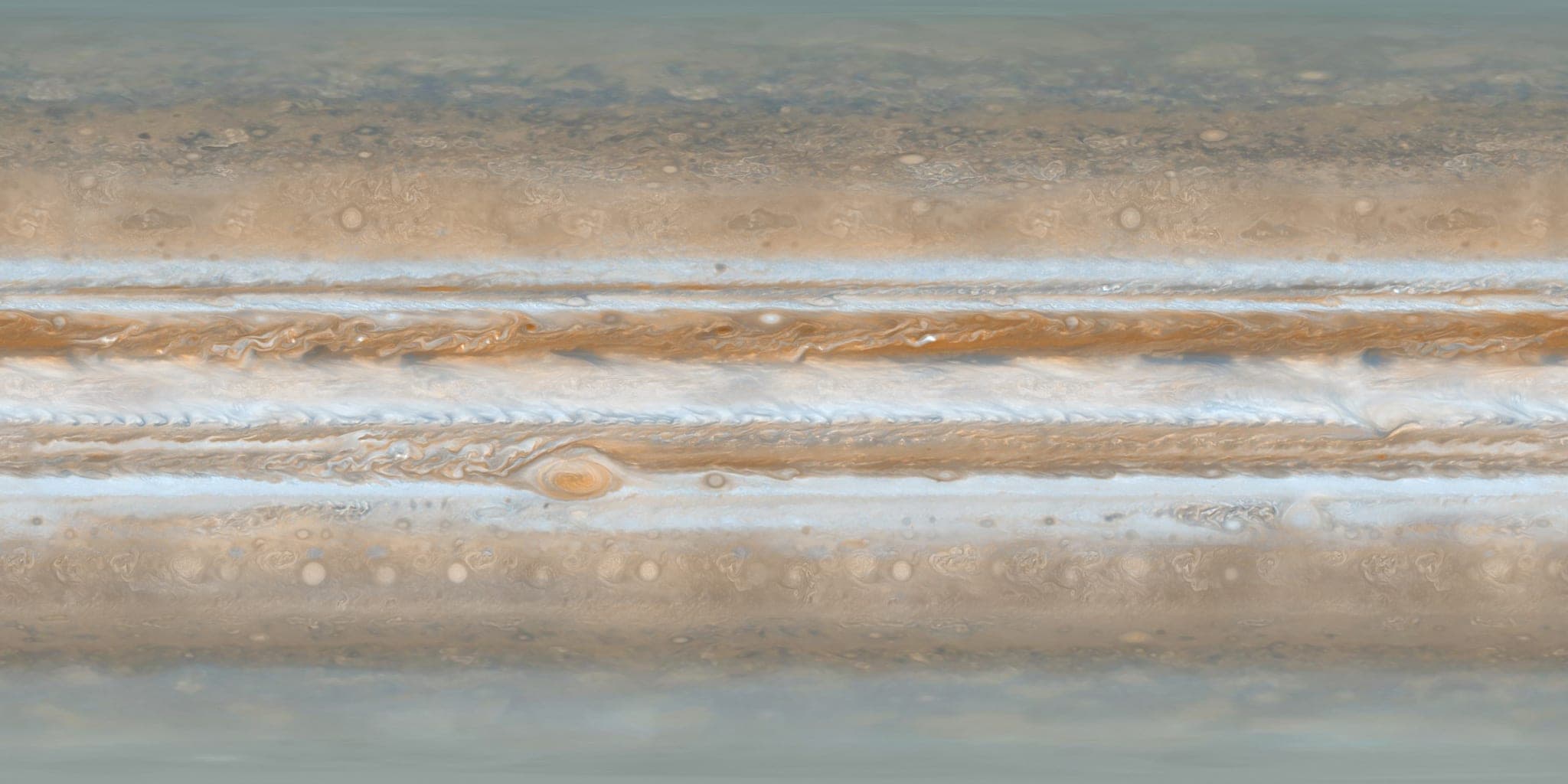
How far below the clouds do the winds that make Jupiter’s bands extend?
Jupiter’s bands are not a pattern made by clouds standing still in neat rows. Powerful east–west winds blowing in opposite directions separate the bright zones from the dark belts. Measurements of Jupiter’s gravity by the Juno spacecraft show that these winds extend about 3,000 km below the visible clouds.
The bands in photographs are the outermost cloud layer of Jupiter’s atmosphere. Jupiter has no solid surface where a person could stand, so researchers use the cloud tops as the reference point for depth. “3,000 km below the clouds” therefore does not mean that the colors of the bands continue that far down. It means that the winds responsible for the bands keep moving to that depth.
- About 9 hours 56 minutes The time Jupiter takes to complete one rotation
- About 3,000 km How far the east–west winds that make the bands extend below the clouds
- About 300 km The estimated depth of the Great Red Spot from microwave observations
- 8 at the north pole · 5 at the south pole The number of giant cyclones surrounding the central storm at each pole
How does rapid rotation create long bands?
Jupiter rotates faster than any other planet in the Solar System. Heat rising from the interior lifts atmospheric gases, while cooler gases sink again. When the effects of rapid rotation are added, flows that were moving north or south curve eastward or westward. Jet streams blowing in opposite directions settle alongside one another and form long bands. Scientists still do not fully understand how these jet streams first arise and remain stable for so long.
Juno did more than photograph the clouds. Its microwave instrument probed ammonia and temperature below them, while radio signals exchanged with Earth measured extremely small changes in the spacecraft’s speed. Winds deep inside Jupiter shift mass slightly and leave a signature in the planet’s gravity. By calculating that signature, researchers concluded that the jet streams extend about 3,000 km below the clouds.
How deep is the Great Red Spot?
The Great Red Spot is an enormous high-pressure storm that has been observed since at least the 1830s. It has survived for a long time, but it has not remained unchanged. Comparisons of observations from different periods show that its width has gradually shrunk, while its outline and color have continued to vary. The Great Red Spot is not a stain fixed on Jupiter; it is weather that is still evolving.
Juno’s microwave instrument tracked the temperature structure beneath the Great Red Spot and estimated the storm’s depth at about 300 km. During separate close passes, the spacecraft also measured the spot’s minute effect on gravity. Researchers analyzing those data found that the mass differences caused by the storm probably do not extend deeper than about 500 km below the clouds. The Great Red Spot reaches much deeper than Earth’s oceans, yet it is shallower than the jet streams that descend about 3,000 km.
The poles of Jupiter present a very different scene. At the north pole, eight giant cyclones surround a central storm; at the south pole, five do the same. The polar regions were difficult to see when Jupiter was viewed from the side from Earth, but Juno’s path over both poles made it possible to photograph this arrangement in detail for the first time. Why these enormous storms maintain their spacing for so long remains under investigation.
The bands and the Great Red Spot in photographs of Jupiter are not markings engraved on a surface. They are momentary views of an atmosphere moving in different directions and at different depths.
Without a solid surface, how can we learn about Jupiter’s interior?
Pressure and temperature rise with depth inside Jupiter, changing the behavior of hydrogen. Near the outside it moves like a gas; farther down it flows more like a liquid and becomes electrically conducting metallic hydrogen. There is no distinct floor where gas ends and liquid begins. From the cloud layer we see to the center, the state of matter changes gradually.
As Juno passes close to Jupiter, it measures precisely how much the spacecraft speeds up and slows down. If mass is not distributed evenly inside the planet, Jupiter’s pull on the spacecraft varies ever so slightly from place to place. Calculating these changes lets researchers estimate where heavy elements are concentrated.
The measurements suggest that rock- and ice-forming materials may not be confined to a small, hard sphere at Jupiter’s center. Some heavy elements may be mixed broadly with the surrounding hydrogen, blurring the boundary between the core and the outer layers. Researchers call this a “diluted core” or a “fuzzy core.” It does not mean Jupiter has no core; it means the central region is more complicated than the simple layered structure shown in textbooks.
Jupiter’s internal structure is not a directly photographed cross-section. It is inferred from models that must jointly match the gravity field, magnetic field, and atmospheric composition, so several interpretations of the core’s size and the distribution of heavy elements remain possible.
How did Jupiter’s magnetic field change the way Juno flies?
Metallic hydrogen deep inside Jupiter conducts electricity. As this material moves while the planet spins rapidly, it acts like a vast generator that produces electric currents and a magnetic field. Juno’s measurements show that Jupiter’s magnetic field is not a simple bar magnet: its strength and direction vary greatly from region to region.
The powerful field traps charged particles and creates dangerous radiation belts around Jupiter. To avoid spending too long in them, Juno follows an elongated orbit that carries it far from the planet before making brief close approaches over the north and south poles. Its electronics are protected inside a thick titanium vault. This unusual flight path allows Juno to see the polar storms and measure gravity and magnetism during the same close passes.
What are photographs of Jupiter actually showing us?
When we see bright zones and dark belts in a photograph of Jupiter, treating them as colors on a solid surface makes us miss the planet’s motion. Winds blow in opposite directions along the boundaries of the bands, and the size and shape of the Great Red Spot change over time. The changing clouds from one image to another are evidence that Jupiter is a continually evolving atmospheric world.
Instead of a camera that directly illuminates the region below the clouds, Juno combined three different clues: microwaves, gravity, and magnetism. Together they revealed that the winds making the bands extend thousands of kilometres deep, that the Great Red Spot is shallower, and that heavy elements may be spread broadly through the central region. Learning to read Jupiter’s appearance is also a way of learning about the interior we cannot see.
Sources
- NASA Science — Jupiter Facts
- NASA Science — Juno Mission
- NASA Science — Juno Probes the Great Red Spot
- Nature — Jupiter’s Atmospheric Jet Streams Extend Thousands of Kilometres Deep
- Science — Microwave Observations of Jupiter’s Atmospheric Vortices
- Science — The Depth of Jupiter’s Great Red Spot
- Nature — Clusters of Cyclones Encircling Jupiter’s Poles