What evidence points to an ocean beneath Europa’s ice?
No spacecraft has drilled through Europa’s ice or photographed its ocean directly. Instead, three observations point to the same conclusion: a fractured surface with few impact craters, a second magnetic field at Europa that changes along with Jupiter’s field, and a moon that repeatedly flexes under Jupiter’s gravity. The strongest evidence is the magnetic measurement, which indicates that an electrically conductive, salty liquid lies inside.
Europa is a moon of Jupiter slightly smaller than Earth’s Moon. Water ice covers its exterior, but explaining the observations together requires an ocean that surrounds the entire moon beneath that ice. Scientists estimate that the ocean may be about 60–150 km deep. This range was not measured directly; it comes from models that must account for the surface terrain, magnetic field, and internal heat at the same time.
- About 3,100 km across Europa’s diameter, slightly less than that of Earth’s Moon
- About 3.55 days the time Europa takes to orbit Jupiter once
- More than twice the water in Earth’s oceans Europa’s total water estimated from interior models
- 49 flybys Europa Clipper’s planned close passes by the moon
What does the fractured icy surface tell us?
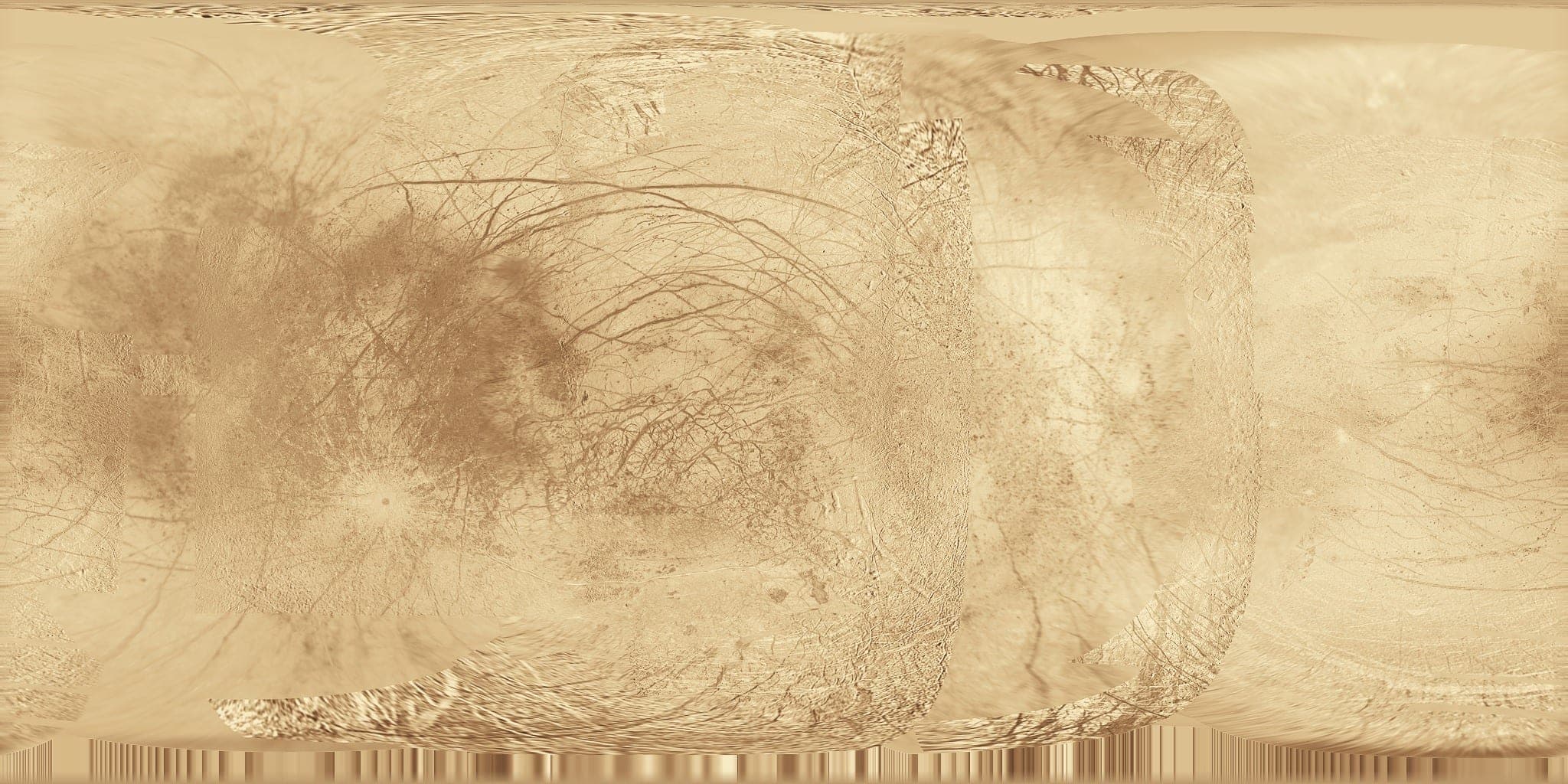
A surface that had changed very little for a long time should retain many craters made by impacts. Large craters are rare on Europa. Instead, fractures thousands of kilometers long and pairs of raised ridges cross the surface. In some regions, enormous pieces of ice look as though they broke apart, rotated, and then froze into place again.
These features show that Europa’s ice shell did not simply freeze once and remain still. Relatively warm ice or liquid may have risen through fractures and covered or pushed aside older terrain. Images alone, however, cannot tell us whether that liquid came from shallow pockets or was connected to a deep ocean. The terrain was an early reason to suspect an ocean, not a photograph that proves one by itself.
How can a magnetic field reveal an ocean we cannot see?
At Europa’s orbit, the direction and strength of Jupiter’s magnetic field change in a regular pattern. The Galileo spacecraft measured a field near Europa that changed with the same rhythm. This means that an electrically conductive material lies inside Europa and that currents flowing through it create another magnetic field.
Pure ice and rock conduct electricity poorly, while water containing dissolved salts conducts it well. The model that best explains the measurements therefore places a broad, salty ocean beneath the ice. A magnetic field created inside an object in response to a changing external field is called an “induced magnetic field.”
Magnetic measurements do not provide every answer. Oceans with different depths, thicknesses, and salt concentrations can produce similar signals. Radar and gravity measurements must be combined with the magnetic data to determine how thick the ice shell is.
Europa’s ocean was not discovered in a photograph of water. It became the most convincing explanation when fractured ice and a repeatedly changing magnetic field pointed to the same place.
How can water remain liquid so far from strong sunlight?
Europa’s orbit is not a perfect circle. Regular gravitational tugs from Io and Ganymede keep it slightly elongated, so Europa moves a little closer to Jupiter and then farther away. Jupiter’s pull changes with that distance, repeatedly stretching and relaxing the entire moon. Friction generated as the ice and interior flex can provide enough heat to keep the ocean from freezing solid.
If water meets rock on the ocean floor, their reactions could produce chemical energy that living organisms might use. Europa’s seafloor has never been seen directly, however, and neither hydrothermal vents nor life have been found there. The possibility of liquid water and usable energy is a reason to examine whether the environment could support life, not evidence that life exists.
The Hubble Space Telescope found signals in some observations that may indicate water vapor rising above Europa, but other observations did not detect the same phenomenon. Possible plumes should therefore not be portrayed as fountains that are always erupting.
What will Europa Clipper try to determine?
Europa Clipper left Earth in October 2024 and changed its speed and direction during a close pass by Mars in March 2025. It is scheduled to pass Earth once more in December 2026 and reach Jupiter in April 2030. Rather than orbit Europa continuously, the spacecraft will orbit Jupiter and make 49 close passes by the moon. This plan limits the time spent in Jupiter’s intense radiation while allowing repeated measurements of different regions.
Ice-penetrating radar will search for layers and pockets of water within the ice shell, while a magnetometer will measure the ocean’s magnetic signal more precisely. Gravity measurements made by tracking the spacecraft’s motion will show how much Europa flexes. Cameras and spectrometers will examine terrain and surface materials together. Comparing whether these instruments point to the same interior structure will improve estimates of the ocean’s depth and the ice shell’s thickness.
Europa Clipper is not designed to detect life directly. It will investigate whether liquid water exists, whether material can move between water and rock, and whether the chemistry and energy that life could use are available. Its mission is to judge whether Europa has an environment capable of supporting life.
How certain is the conclusion that Europa has an ocean?
A sparsely cratered surface marked by change cannot, on its own, confirm an ocean surrounding the entire moon. The magnetic field alone cannot distinguish the ocean’s exact depth from its salt content. Yet the surface terrain, induced magnetic field, and repeated tidal heating do not contradict one another and can all be explained by the same ocean model. Together, they provide strong evidence.
Long lines and broken blocks in images of Europa need not be read as mere surface patterns. They record an ice shell that has moved, while the field measured by Galileo indicates an electrically conductive liquid below. Europa Clipper will measure both clues in the same regions and bring the ocean—still known only through models—into sharper focus.
Sources
- NASA Science — Europa Facts
- NASA Science — Evidence for an Ocean
- NASA Science — Galileo Magnetic Evidence
- Science — Galileo Magnetometer Measurements
- NASA Science — Europa Clipper
- NASA Science — Europa Clipper Mission Timeline
- NASA — Europa Clipper Mission Science
- NASA Science — Hubble Possible Water Vapor Plumes