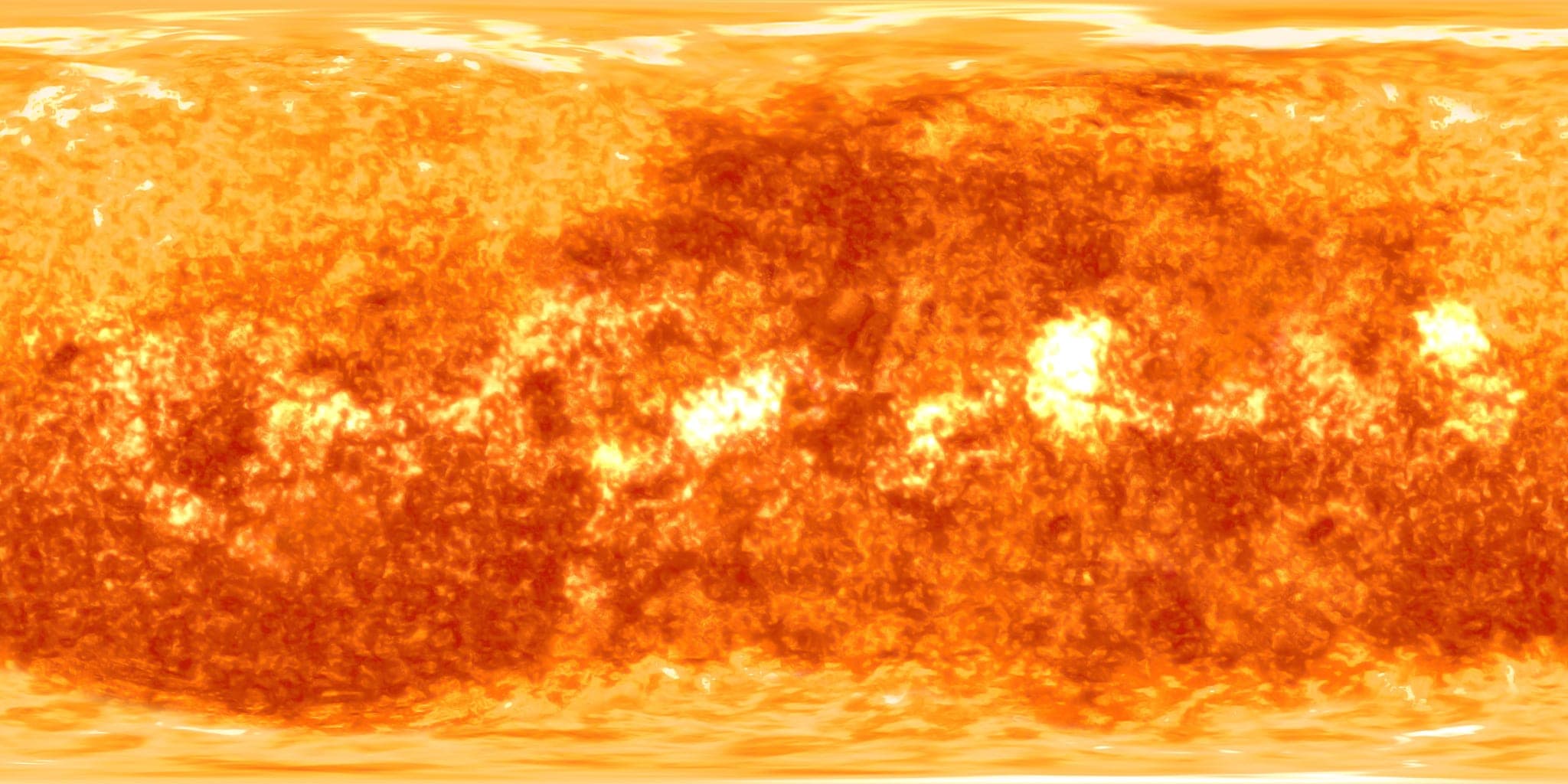
The Sun: where the Solar System's orbits and life begin
Without the Sun, the planets could not follow the orbits they do today, and Earth could not support its present diversity of life. The Sun's gravity holds planets, asteroids, and comets together in an ordered system, while the energy and particles it releases constantly change environments across the Solar System. The bright disk we see in the sky each day is the central star that shapes both the structure of our cosmic neighborhood and the conditions that make life possible.
The Sun is a roughly 4.6-billion-year-old star made of hydrogen and helium. Its own gravity holds its vast plasma together. About 99.8% of the Solar System's mass is concentrated in the Sun, so it controls planetary orbits and keeps the pressure and temperature in its core high enough to shine for billions of years. In about 5 billion years, when hydrogen in the core runs out, the Sun will swell into a red giant and engulf Mercury and Venus. Earth will become uninhabitable before then and may eventually be swallowed as well. The Sun will later shed its outer layers and remain as a white dwarf, while the surviving outer planets circle the cooling remnant in wider orbits.
- About 15 million°C temperature at the Sun's center, where hydrogen joins to release energy
- About 170,000 years time for energy from the center to pass through the radiative zone and reach the outer layers
- About 5,500°C temperature of the photosphere, the layer we see as the Sun's surface
- Up to several million°C temperature the corona, the Sun's outer atmosphere, can reach
How does energy from the Sun's center move outward?
In the core, hydrogen nuclei join to make helium, and a tiny difference in mass becomes energy. But that energy is not packed into one photon that flies straight to the surface. In the radiative zone, light interacts with particles and keeps changing direction and energy. “About 170,000 years” is not the travel time of one ray of light. It is the time energy from the Sun's center takes to pass through several layers and reach the outside.
Farther out, hot plasma rises through the convection zone while cooler material sinks. The grain-like pattern on the photosphere is the surface trace of this immense churning. Even the photosphere, which we call the surface, is not a solid shell. It is closer to a visible boundary: below a certain depth, plasma becomes opaque and light has trouble escaping.
Sunlight does not reach the surface from the center in one quick trip. Energy moves through matter countless times before it finally escapes into space.
Why does solar activity change about every 11 years?
The Sun is made of electrically charged plasma, and its rotation and internal flows generate magnetic fields. The equator and higher latitudes do not rotate at the same speed, while flows inside the Sun twist and wind magnetic field lines. Over a cycle of about 11 years, sunspots and eruptions grow more and less active, and the north and south magnetic poles reverse. The length and strength of each cycle are never exactly the same.
Sunspots are not holes. They are regions where strong magnetic fields slow convection, making them look cooler and darker than their surroundings. When twisted magnetic fields reconnect, flares and coronal mass ejections can send energy and matter into space. Particles and magnetic changes that reach Earth can create auroras, but strong events can also affect satellite electronics, communications, power grids, and astronauts' radiation exposure.
Solar activity grows stronger and weaker over a cycle of about 11 years, but no two cycles repeat at exactly the same time or strength. Sunspots are only one clue to the Sun's condition. The direction of an eruption and the shape of its magnetic field also matter.
An atmosphere hotter than the surface
Above the photosphere, the Sun's visible surface, lie the chromosphere, transition region, and corona. We might expect the temperature to fall farther from the heat source, but the Sun's atmosphere does the opposite. The temperature rises again in the corona and can reach several million degrees. The corona is extremely thin, but its particles move very quickly, and motions in the magnetic field seem to add energy. Scientists are still studying exactly how the corona becomes so hot.
Some particles in the corona escape the Sun's gravity and spread into space as the solar wind. The solar wind has fast and slow streams. As they travel farther, the streams mix and their original features become harder to see. That is why scientists go close to the Sun to learn where the solar wind begins and how it speeds up.
- Fusion turns hydrogen into helium in the core and releases energy.
- Radiation and convection redistribute energy through the dense interior and lift hot plasma toward the surface.
- Magnetic atmosphere carries twisted fields above the photosphere, heating the corona and sometimes reconnecting explosively.
- Solar wind extends escaping plasma and magnetic fields beyond the planets to form the heliosphere.
How close did Parker Solar Probe get to the Sun?
After its launch in 2018, Parker Solar Probe used Venus's gravity to tighten its orbit. In 2021, it crossed the Alfvén critical surface—the boundary between solar material still held to the Sun and material escaping outward—and flew directly through the corona. Measurements showed that this boundary is not a smooth sphere. It is uneven, and the probe can cross it several times during one pass.
In December 2024, Parker Solar Probe came within about 6.1 million kilometers of the Sun's surface. It did not land on the Sun or enter its interior. From behind a shield that blocks the intense heat, it measured magnetic fields, plasma, and high-energy particles and took images of the solar wind. Scientists can now do more than watch the Sun from afar: they can study up close what is happening around our nearest star.