Earth, the Blue Planet Shaped by Water and Life
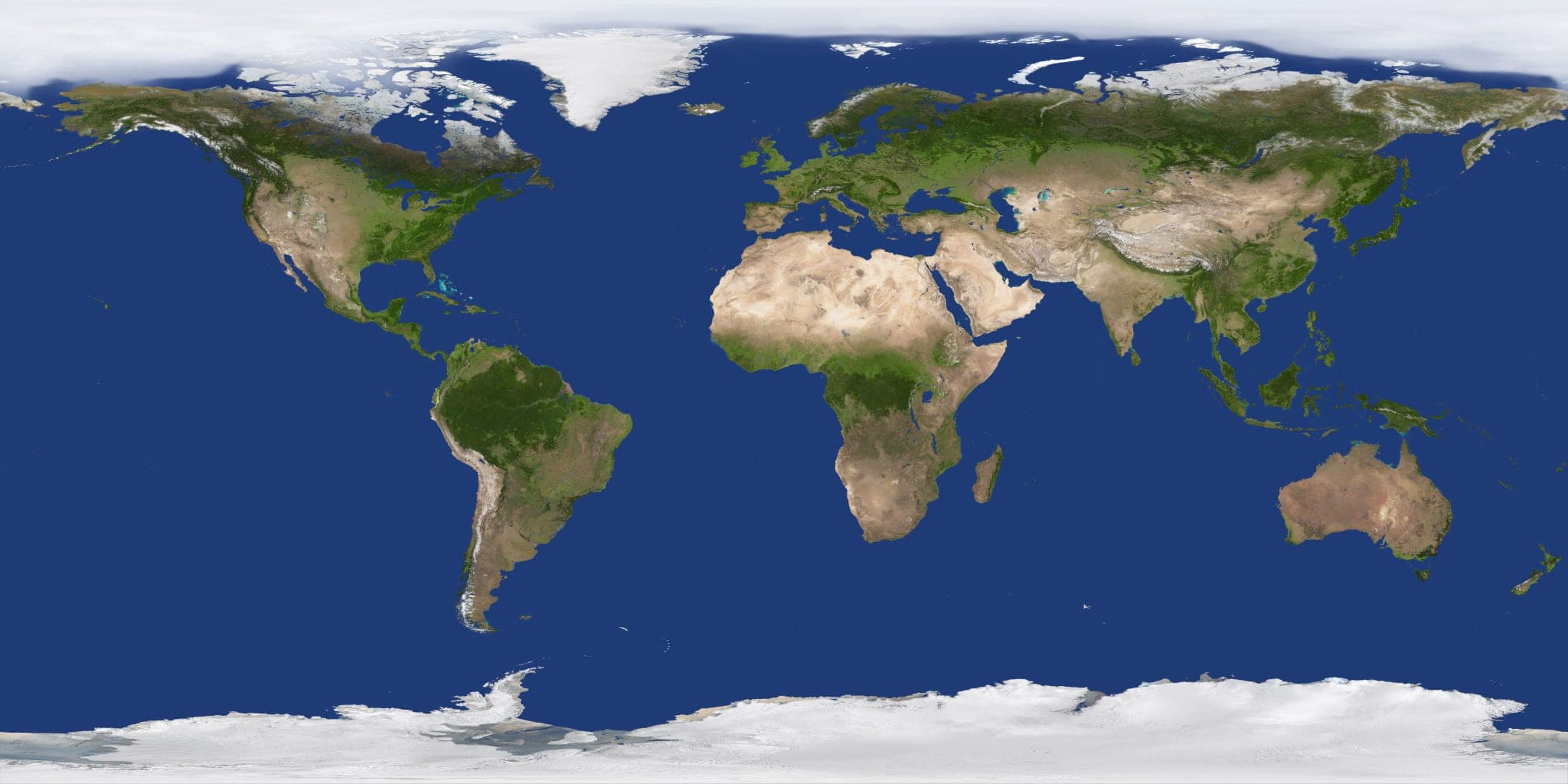
The main reason Earth looks blue from space is the ocean, which covers about 71 percent of its surface. Water absorbs more of the red wavelengths in sunlight, leaving more blue light for our eyes to see. But color alone is not what makes Earth remarkable. The circulation of liquid water, the atmosphere’s regulation of heat, the ceaseless motion of Earth’s crust, and the interplay between life and its environment have together shaped the Earth we know today.
The ocean does not always appear the same shade of blue. Depending on how sediments, microscopic organisms, and suspended particles absorb and scatter light, it may look green, brown, or sometimes reddish. Earth’s water does not remain in the ocean. As it freezes, melts, evaporates, and condenses, it circulates continuously through the ocean, atmosphere, surface, and underground.
- About 71% of Earth’s surface is covered by ocean
- About 97% of Earth’s water is stored in the ocean
- About 78% and 21% are the shares of nitrogen and oxygen in air near the surface
- Ice, liquid water, and water vapor The same water changes form as it moves among the ocean, sky, and land
How can water remain liquid on Earth’s surface?
For water to stay liquid on the surface for long periods, the surroundings must be neither too hot nor too cold. Earth’s temperature is not set by its distance from the Sun alone. It also depends on the energy Earth receives from sunlight and the heat that leaves through the atmosphere and returns to space.
Sunlight warms the surface, and the warm surface sends energy back out as heat. Greenhouse gases such as water vapor and carbon dioxide absorb some of that heat, keeping it from escaping directly to space. This is the natural greenhouse effect. It keeps Earth warm enough for liquid water to exist.
The greenhouse effect is not harmful by itself. The natural greenhouse effect is a basic process that keeps Earth warm. The problem is that people burn fossil fuels such as coal, oil, and gas, adding carbon dioxide and causing the atmosphere to hold more heat than it did before.
How does Earth’s water keep circulating?
Solar energy warms water in oceans, lakes, and soil, turning some of it into vapor that rises into the air. Higher up, cooler air changes the vapor into tiny water droplets or ice crystals, which fall back to the surface as rain or snow. The water then flows through rivers, seeps underground, or remains stored as ice. This continuous movement between places and states is called the water cycle.
- Evaporation The Sun warms water in oceans, lakes, and soil, turning some of it into vapor.
- Condensation Rising vapor cools into tiny water droplets or ice crystals that form clouds.
- Precipitation Droplets and ice crystals fall as rain or snow after growing large and heavy enough.
- Flow and storage Water moves through rivers and underground, returns to the ocean, or remains in lakes, ice, and groundwater.
The same water moves among oceans, clouds, rivers, and ice, connecting Earth’s weather and its living things.
How can land that looks still be moving?
Earth’s rigid outer layer is not one unbroken shell. It is divided into enormous pieces called plates. Each plate moves at a different speed and in a different direction, but the motion is generally about as slow as a fingernail grows. That is why we cannot feel it in everyday life.
Over very long periods, plates that push against and collide with one another can build mountain ranges. Where plates separate beneath the ocean, new seafloor forms. If friction holds a plate boundary in place and it suddenly slips, an earthquake can occur. The continents and oceans we see now are the result of changes that have continued for a very long time.
How did life change Earth’s air?
Plants, algae, and some bacteria use sunlight to make the food they need from water and carbon dioxide, releasing oxygen in the process. This is called photosynthesis. Earth’s atmosphere was not always as rich in oxygen as it is today. Oxygen made by photosynthetic life in the ocean accumulated over time, and atmospheric oxygen began to rise sharply about 2.4 billion years ago.
Living things do more than respond to their environment. They change the properties of water, air, and soil, and the changed environment then affects life in return. Earth’s environment and its living things did not develop separately; they have changed together by influencing one another.
What does Earth reveal when seen from space?
The blue areas are oceans of liquid water, and white clouds show that some of that water is moving through the atmosphere. Even continents that seem motionless are slowly shifting. Plants, algae, and tiny microorganisms change the makeup of air and water. A single image of Earth contains signs of moving water, moving ground, and living things.
Earth’s environment was not produced by any one condition. Energy from the Sun, a heat-regulating atmosphere, water cycling among the ocean, sky, and land, slowly moving plates, and life that changes its surroundings are all connected. So far, no evidence of life beyond Earth has been confirmed. That does not mean other worlds have no life; it means we have not found it yet.