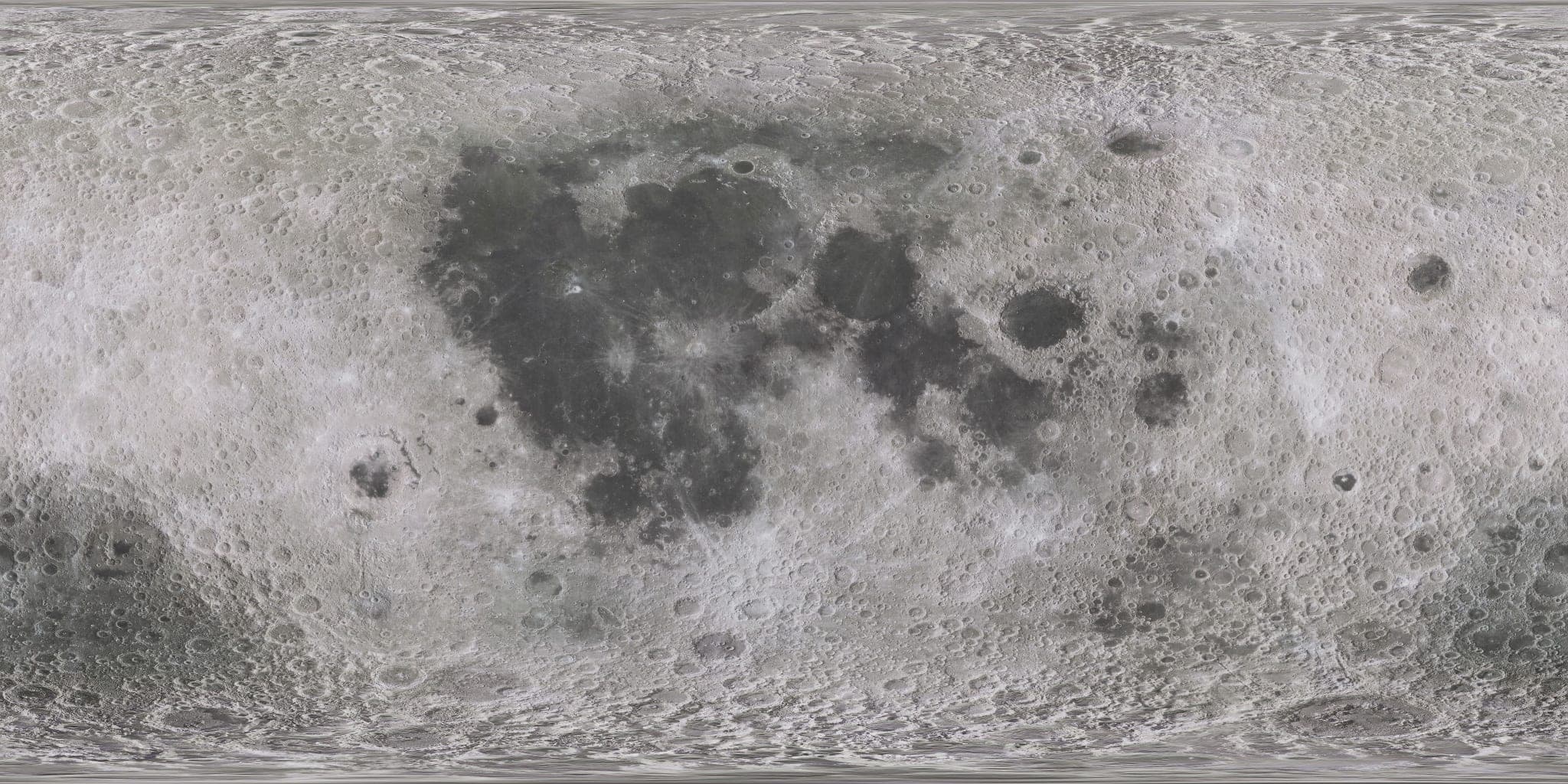
What do the Moon’s patches and craters tell us?
The Moon’s bright and dark patterns and its many craters are more than surface markings. The bright areas preserve ancient lunar crust, while the dark areas hold lava that flowed after enormous impacts. With almost no rain, wind, or active plate movement to erase them, traces of events from the distant past remain readable on the Moon today.
This does not mean the Moon is a completely frozen world. Small space rocks continue to strike its surface, and moonquakes occur as its interior cools and contracts. The presence of ancient traces and small changes still happening today makes the lunar surface an exceptional record.
Why does the Moon show us almost the same face?
The Moon rotates once about every 27 days, and it takes almost the same amount of time to orbit Earth. Because these two periods match, one hemisphere keeps facing Earth, a condition called tidal locking. Seeing the same face does not mean the Moon has stopped rotating.
The lunar far side, which cannot be seen from Earth, also receives sunlight and goes through day and night. Calling it the “dark side” does not describe its actual brightness. After the Soviet Luna 3 spacecraft first photographed the far side in 1959, later orbiters mapped in detail its more heavily cratered surface and thicker crust.
- About 384,400 km the average distance between Earth and the Moon
- About 27 days both the Moon’s rotation period and its orbital period around Earth
- About 1/6 of Earth’s the gravity felt on the lunar surface
- 382 kg of lunar rocks and soil returned by Apollo astronauts
Why are the bright and dark areas different?
The most widely supported explanation says the Moon formed about 4.5 billion years ago from material thrown out after a large body struck the young Earth. The newly formed Moon was mostly molten. As it cooled, lighter, brighter minerals floated upward and made the first crust. Today’s bright highlands, crowded with craters, preserve part of that ancient crust. Scientists continue to study samples and models to understand the impact’s exact sequence.
Later, enormous impacts made broad, low basins. Dark basaltic lava rose from inside the Moon, filled some of those basins, and hardened into plains. Early observers thought these dark regions looked like bodies of water and called them maria, Latin for “seas,” but lunar seas are solidified lava, not water.
The lunar surface is old not because nothing ever happened there, but because there was almost no rain or wind to erase the traces of many events.
How do scientists read the Moon’s timeline?
Terrain with more craters is generally older, while lava plains with fewer craters were resurfaced later. Photographs alone, however, cannot give exact ages. Laboratory measurements of the 2,196 samples—382 kg of rock and soil—returned by Apollo’s six landing missions allowed scientists to connect ages measured in numbers with landforms seen in images.
Researchers still analyze these samples with new instruments. Yet all of them came from six sites near the equator on the Moon’s near side, so they do not represent the whole Moon evenly. New samples from the far side and polar regions could make the present timeline more precise or change parts of it.
- Telescopes and photographs compare the distribution of bright highlands, dark plains, and craters.
- Apollo samples reveal the composition and age of rocks, attaching measured dates to photographed terrain.
- Apollo seismometers recorded the unseen lunar interior and several kinds of moonquakes.
- The LRO orbiter has repeatedly measured terrain, temperature, and composition since 2009, linking older maps with changes observed today.
Where does water exist on the Moon, and in what form?
The Moon has no oceans or rivers, but it is not completely without water. Instruments have detected small amounts of water molecules inside sunlit soil grains or attached to their surfaces. Near the lunar poles, some deep craters receive no sunlight for long periods. Water ice has been confirmed in these extremely cold permanently shadowed regions.
This does not mean water is plentiful across the Moon. It is sparsely distributed, and its location and form vary. Scientists are still investigating how deeply the ice is buried and how much of it could actually be used. The statement “there is water on the Moon” should therefore be read together with where and how it was detected.
The sparse water molecules detected in sunlit areas and the water ice gathered in cold polar shadows exist in different environments. The two observations should not be combined into an image of lakes or broad sheets of ice.
Is the Moon still changing?
The Moon’s interior has cooled and contracted little by little over a long time. As the crust narrowed, faults formed where one piece of ground was pushed over another, creating low cliffs. Scientists estimate that the Moon’s diameter has decreased by about 50 m over the past several hundred million years, and they think it may still be contracting slowly.
Moonquakes do not all have the same cause. Earth’s gravity can tug on the lunar interior, the large temperature change between day and night can expand and contract surface rocks, and meteorite impacts can produce vibrations. Shallow moonquakes can also occur when a fault suddenly moves after cooling and contraction inside the Moon. Seen together, old impact craters and younger faults show that the Moon preserves its past while adding new traces at a very slow pace.