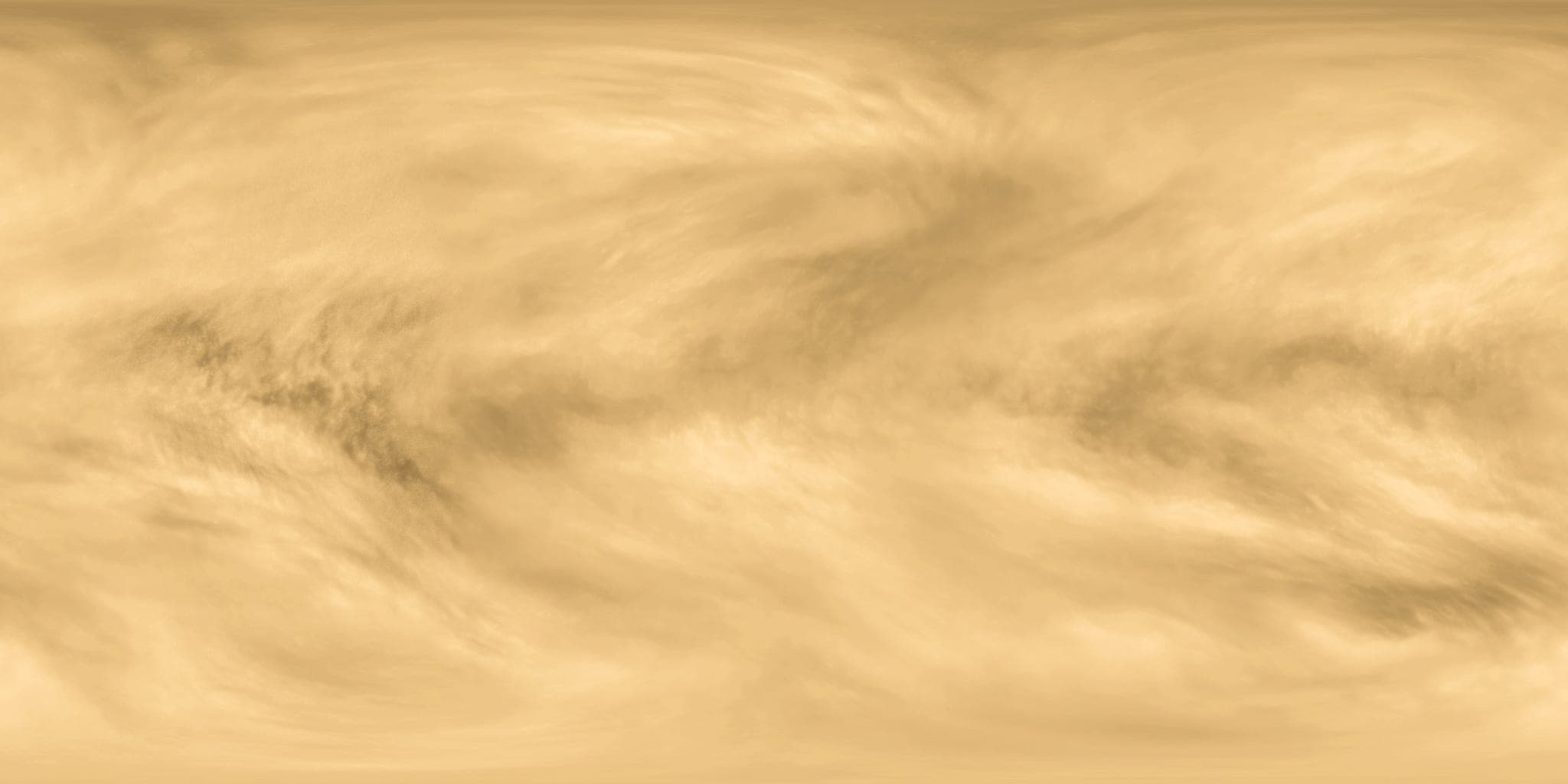
How did Venus, nearly Earth’s size, become the hottest planet?
Venus is the hottest planet in the solar system, but not simply because it is closer to the Sun. Its thick carbon dioxide atmosphere makes it difficult for heat from the surface to escape. Venus is similar to Earth in size and internal structure, yet its surface is now about 467°C and its atmospheric pressure is roughly 93 times the pressure at Earth’s sea level.
Scientists still do not fully know how Venus and Earth became so different. Understanding the split requires looking beyond today’s atmosphere to ask whether Venus once had water and what gases its volcanoes added to the air.
- About 12,104 km wide roughly 95% of Earth’s diameter
- About 467°C the highest surface temperature of any planet in the solar system
- About 93 times Earth’s pressure at the surface of Venus
- Mostly carbon dioxide the main gas in an atmosphere that slows the escape of heat
The bright clouds and the thick atmosphere do different jobs
Clouds of sulfuric acid droplets cover Venus and reflect much of the sunlight that reaches them. That is why Venus looks so bright in the night sky. Energy that passes through the clouds and warms the surface travels upward again as infrared radiation, and the thick carbon dioxide atmosphere repeatedly absorbs and emits that radiation.
This process makes it difficult for energy at the surface to escape into space. The greenhouse effect is also a natural part of Earth’s climate, but the amount and makeup of Venus’s atmosphere are very different and have produced extreme heat. NASA describes the planet’s present state as the result of a runaway greenhouse effect.
Venus’s clouds reflect sunlight, but the enormous carbon dioxide atmosphere beneath them makes it difficult for heat from the surface to escape into space.
We still do not know whether Venus once had an ocean
Deuterium, a heavy form of hydrogen, is far more abundant relative to ordinary hydrogen in Venus’s atmosphere than it is on Earth. Because lighter hydrogen escapes into space more easily, this ratio supports the possibility that Venus once had more water than it does now. The measurement alone, however, cannot prove that a liquid ocean covered the surface.
Scientists are testing two different histories. Some climate models suggest that Venus cooled enough to form a shallow ocean and may have remained mild for a long time. Other research suggests that the planet was too hot from the beginning for water vapor to fall as rain and make an ocean. Distinguishing between them will require more precise measurements of the atmosphere and rocks.
An “ancient ocean on Venus” is one possible history. The high deuterium ratio is evidence of water loss, not a photographed shoreline or direct proof of an ocean.
Radar searches for volcanoes beneath the clouds
Venus’s thick clouds hide the surface from visible-light cameras. NASA’s Magellan spacecraft sent radio waves toward the planet and used their returning echoes to map 98% of the surface. Those data indicate that volcanic flows cover at least 85% of Venus.
Researchers compared radar observations from 1990 and 1992 and found changed signals around Sif Mons and Niobe Planitia. After accounting for slopes and obstacles in the terrain, newly erupted and hardened lava was the explanation that best matched the changes. Magellan did not film an eruption directly, but the observations show that the surface of Venus changed during the early 1990s.
New missions will examine the atmosphere and surface separately
- While descending through the atmosphere the DAVINCI probe is designed to measure gases, pressure, temperature and winds, then image Alpha Regio beneath the clouds.
- While mapping the surface again from orbit VERITAS is planned to use new radar maps, gravity data and spectroscopy to study volcanoes and the planet’s interior after 2031.
- While looking beneath the surface ESA’s EnVision, targeting a November 2031 launch, is planned to use radar and spectrometers to observe the subsurface, surface and atmosphere together.
The three missions measure different materials at different altitudes because no single kind of evidence can reconstruct Venus’s history. Atmospheric gases can narrow down when water was lost, while rocks and volcanoes can reveal what materials rose from the planet’s interior.
Venus shows that size alone cannot predict a planet’s future
Venus is not a direct picture of Earth’s future. Instead, it is a comparison showing that planets of similar size can become entirely different when changes in atmospheric mass, water, volcanoes and rocks accumulate over long periods.
The bright, smooth appearance of Venus is made by high clouds, not by its solid surface. The hottest ground and traces of volcanoes lie hidden below. Radar and atmospheric probes connect those two layers as scientists work out the sequence that made Venus the planet we see today.