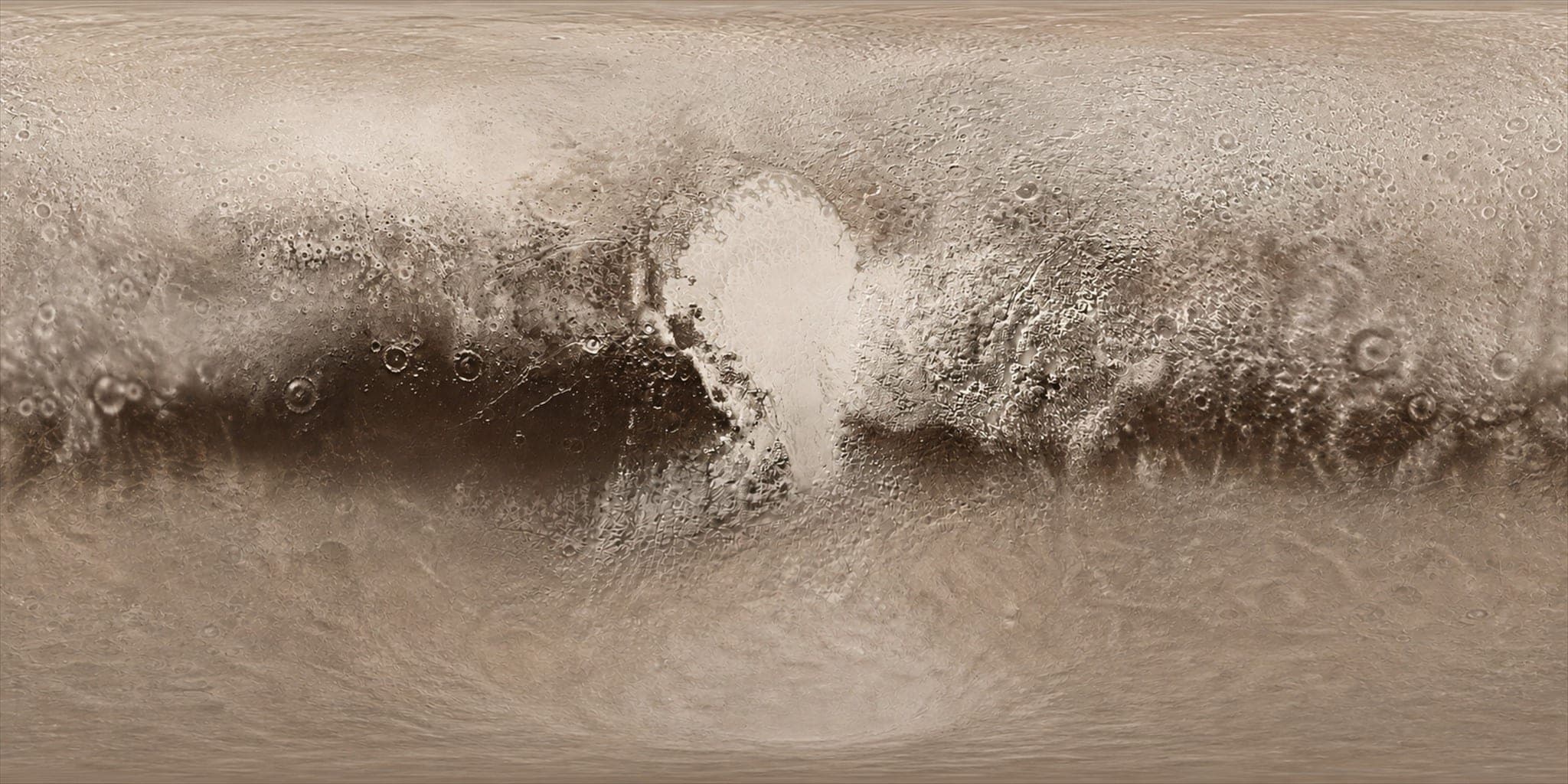
On Pluto, water ice builds mountains while nitrogen ice flows
Pluto’s surface temperature is about −226°C to −240°C. At these temperatures, water ice is strong enough to support mountains. Nitrogen ice, however, can flow like a glacier over very long periods. Where it forms a thick layer, it can also move slowly up and down while remaining solid. The mountains, glaciers, and polygon-shaped plains discovered by New Horizons in 2015 formed in different ways because each kind of ice behaves differently.
Pluto is about 2,377km across, roughly two-thirds the diameter of Earth’s Moon. It lies an average of about 39AU from the Sun and takes 248 years to complete one orbit. Because its orbit is elongated, its distance from the Sun ranges from about 30AU to 49AU. As conditions change, some nitrogen, methane, and carbon monoxide ice turns into gas or freezes again, moving between the surface and the atmosphere.
- About 2,377km Pluto’s diameter
- About 39AU on average Roughly 39 times the distance from Earth to the Sun
- About 153 hours Time Pluto takes to rotate once
- About 248 years Time Pluto takes to orbit the Sun once
Water ice forms mountains, while nitrogen ice flows
Some mountains seen in New Horizons images rise 2–3km above Pluto’s surface. Nitrogen and methane ice are too soft to support mountains this tall for long, so scientists interpret hard water ice as their main material. Infrared spectra also show water ice across wide areas. In some places, layers of nitrogen, methane, and carbon monoxide ice cover it and hide its signal.
Nitrogen ice can deform like a glacier even at Pluto’s low temperatures if given enough time. Images preserve signs that it flowed from high ground into a lower basin and curved around obstacles. Pieces of water ice are less dense than the surrounding nitrogen ice and can rise to its surface. Clusters of these pieces have collected along the edge of Sputnik Planitia.
Materials called “ice” do not all behave alike on Pluto. Water ice becomes firm ground, while nitrogen ice flows like a glacier and reshapes the surface.
Solid nitrogen ice slowly circulates in Sputnik Planitia
Sputnik Planitia, about 1,000km wide, lies in the western half of the heart-shaped Tombaugh Regio. This low basin is a vast glacier made mostly of nitrogen ice, mixed with methane and carbon monoxide ice. Polygon-shaped areas 16–48km across cover the surface, and almost no impact craters are visible. This means the plain was resurfaced much more recently than the heavily cratered terrain around it.
The polygons can be explained by a model in which solid nitrogen ice several kilometres thick circulates extremely slowly. Ice warmed slightly from below rises, while ice cooled at the surface moves toward the polygon edges and sinks. This does not mean the nitrogen is liquid or boiling. It means that even solid ice that looks rigid can move over long periods and cover the surface with newer ice.
A low crater count tells scientists that a surface changed later than nearby terrain. Images alone, however, cannot show exactly when every part of the plain changed or whether it all changed at the same rate.
Surface ice supplies Pluto’s thin atmosphere
Pluto’s atmosphere is mostly nitrogen, with methane and carbon monoxide as well. When sunlight turns surface nitrogen ice directly from a solid into a gas, the atmosphere grows. When temperatures fall, some of that gas freezes back onto the surface. Atmospheric pressure therefore depends on more than Pluto’s distance from the Sun. It is also affected by which regions receive sunlight and how heat stored below the ground changes the surface temperature.
When New Horizons observed sunlight passing through Pluto’s atmosphere from behind the dwarf planet, it saw many layers of haze extending more than 160km above the surface. Ultraviolet light breaks apart methane high in the atmosphere and produces a variety of hydrocarbon particles. As these particles settle, they become part of the material that gives the surface its reddish-brown colour. The haze itself looks blue because its tiny particles scatter blue light more effectively.
Much of the atmosphere may freeze as Pluto moves farther from the Sun, but distance alone cannot tell us when this will happen or how much atmosphere will remain. The 2015 flyby measured only one moment in Pluto’s 248-year orbit. To track long-term changes, astronomers must continue watching Pluto pass in front of stars and measure the starlight that travels through its atmosphere.
- Sublimation Sunlit nitrogen and methane ice turns partly into gas and replenishes the atmosphere.
- Atmospheric transport The gas spreads to other regions and freezes again where temperatures are lower.
- Glacial flow Accumulated nitrogen ice moves slowly from high ground toward the Sputnik basin.
- Solid-state convection Thick nitrogen ice in the basin circulates up and down, renewing the surface.
Large fractures suggest that an ocean may remain underground
Pluto has large fractures that stretch for hundreds of kilometres. If the whole dwarf planet had contracted, its surface should show many signs of being compressed and crumpled. Instead, the clearer marks come from the icy crust stretching and splitting. Models can explain these fractures if underground water slowly froze and expanded, or if liquid water that still remains pushed against the icy crust.
The location of Sputnik Planitia provides another clue to a possible underground ocean. If liquid water remains beneath the basin, or if a thick layer of nitrogen ice made the area heavier than its surroundings, the basin may have shifted to its present position as Pluto rotated. No orbiter has yet mapped Pluto’s gravity in detail or measured seismic waves there. An underground ocean is therefore a strong model that can explain several landforms, not a layer of water that has been directly confirmed.
Only one spacecraft has seen Pluto up close
New Horizons launched in 2006 and passed about 12,500km above Pluto’s surface on 14 July 2015. It remains the only spacecraft to have studied Pluto at close range. The spacecraft collected about 6.25GB of data with cameras, spectrometers, and particle instruments, and took more than 15 months to transmit it all to Earth.
The flyby revealed the terrain and atmospheric structure of one hemisphere in detail, but it could not measure how the same areas change through the seasons. The existence of an underground ocean, the exact thickness of the nitrogen-ice layer, and long-term changes in atmospheric pressure still depend on indirect evidence. An orbiter that remains around Pluto and observes its terrain, gravity, and atmosphere at many times would be needed to answer these questions more precisely.
A dwarf planet can still have an active, changing surface
Pluto was classified as a dwarf planet under the International Astronomical Union’s 2006 definition. That name is simply a way of grouping bodies that orbit the Sun; it does not mean Pluto is a motionless ball of ice. Mountains of water ice rise above its surface, nitrogen glaciers flow, and surface ice exchanges material with the atmosphere. New Horizons showed that landscapes can keep changing even on a small, extremely cold world.
Sources
- NASA Science — Pluto Facts
- NASA Science — New Horizons
- NASA — Pluto’s Heart: Like a Cosmic “Lava Lamp”
- NASA — New Findings Shape Understanding of Pluto and Its Moons
- NASA — New Horizons Discovers Flowing Ices on Pluto
- NASA — Pluto’s Widespread Water Ice
- NASA Science — Pluto at Twilight
- NASA — Scientists Probe Mystery of Pluto’s Icy Heart