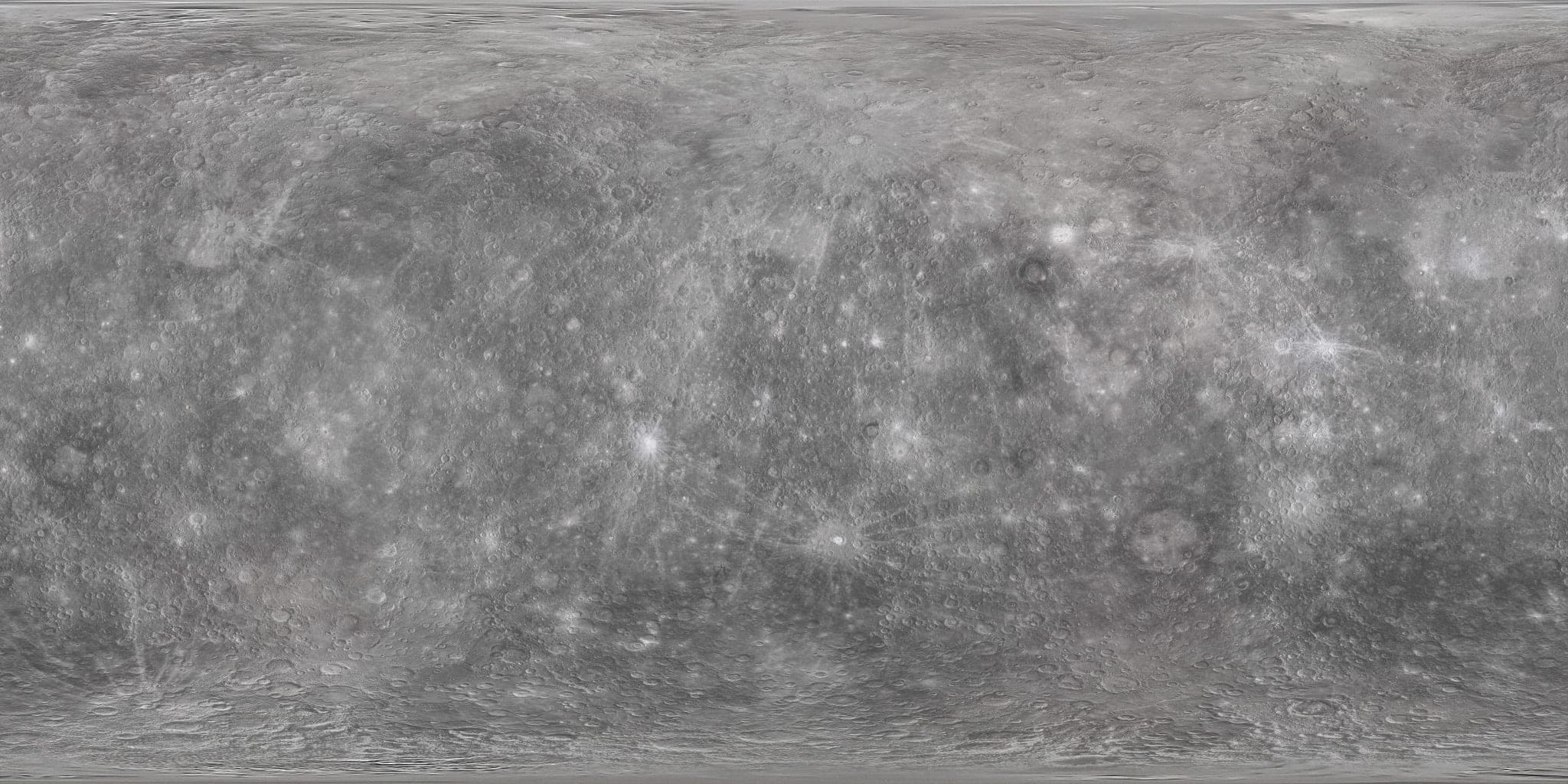
How can ice remain on Mercury, the planet closest to the Sun?
Mercury is the closest planet to the Sun, but it is not always hot everywhere. Its surface can reach about 430°C during the sunlit day and fall to about -180°C during the long night, while water ice remains inside polar craters that sunlight never reaches. These extremes can exist on one planet because Mercury has no thick atmosphere to move heat, its day is extremely long, and its spin axis is barely tilted.
These temperatures do not mean that all of Mercury is 430°C and -180°C at the same time. They are representative extremes that occur in different places and at different times. To understand Mercury, we must consider not only its distance from the Sun but also where sunlight falls and how long it stays there.
- 88 Earth days one Mercury year, or one orbit around the Sun
- About 59 Earth days one rotation measured against the stars
- 176 Earth days the time from one local noon to the next
- About 430°C and -180°C representative surface extremes during day and night
Being closest does not make Mercury the hottest planet
Mercury's daytime surface is fiercely hot, but Venus is the hottest planet in the Solar System. Venus has a thick atmosphere that makes it difficult for heat to escape into space. Mercury, by contrast, has no thick layer of air to hold daytime heat and carry it to the night side, so its surface cools quickly after sunset.
This is why a planet's temperature cannot be explained only by saying that being closer to the Sun means receiving more sunlight. How well its atmosphere and surface store and move the energy also matters. Mercury's enormous difference between day and night is what happens when this second condition barely works.
On Mercury, a day is longer than a year
A year on Mercury lasts about 88 Earth days. Measured against the stars, Mercury takes about 59 days to turn once and face the same direction again. Over about 176 days, Mercury completes two orbits around the Sun while rotating three times on its axis. This matching of two orbits with three rotations is called a 3:2 resonance.
Completing one rotation does not mean that the Sun seen from Mercury's surface has already returned to the same place in the sky. Mercury keeps moving around the Sun while it rotates. As a result, about 176 days pass at one location between one noon and the next. Mercury also changes orbital speed along its elongated orbit, so in some regions the morning Sun can appear to rise briefly, set, and then rise again.
Distance from the Sun is not the only thing that divides Mercury's hot and cold regions. How long sunlight lasts and whether air can carry heat also decide the temperature.
Some craters never receive sunlight
Mercury's spin axis is tilted by only about 2° from the direction perpendicular to its orbital plane. Because of this, the Sun never rises above the horizon on the floors of some deep impact craters near the poles. Only these permanently shadowed regions—not the entire poles—stay cold enough for water ice to survive for a long time.
Ground-based radar first detected bright reflections from polar craters that matched what scientists expected from ice. MESSENGER later combined temperature, neutron, and surface-brightness data, supporting the conclusion that the deposits are mostly water ice. The ice may lie exposed on crater floors or be buried tens of centimeters below the surface.
Mercury's polar ice is not evidence of a liquid ocean or of life. It is ice preserved in a small number of craters that receive no sunlight, and its amount, origin, and movement are still being studied.
With almost no air, the surface meets space directly
Mercury is not a perfect vacuum, but it has no atmosphere thick enough to make weather. When the solar wind and tiny meteoroids strike the surface, atoms such as oxygen, sodium, hydrogen, helium, and potassium are knocked loose and form an extremely thin exosphere. These atoms do not remain for long: they escape into space and are then supplied again from the surface.
Mercury also has a magnetic field generated inside the planet. Its measured strength at the surface is about 1% of Earth's magnetic field, and its center is shifted north of Mercury's center. As the weak magnetic field meets the powerful solar wind, particles descend toward the surface and knock out more atoms, so Mercury's surface and the surrounding space continually affect each other.
Even this nearby planet takes a long time to reach
Mercury is closer to the Sun than Earth is, but a spacecraft cannot simply fly straight there and stop. A spacecraft heading inward speeds up under the Sun's gravity, so it must lose a great deal of speed to enter orbit around Mercury. That is why MESSENGER and BepiColombo used the gravity of Earth, Venus, and Mercury many times.
- 1974–1975 Mariner 10 flew past Mercury three times and observed part of its surface and its own magnetic field.
- 2011–2015 MESSENGER became the first spacecraft to orbit Mercury and studied its surface, composition, magnetic field, and polar ice.
- 2018–2025 After launch, ESA and JAXA's BepiColombo adjusted its speed through nine planetary flybys.
- Planned for 2026–2027 The spacecraft begins entering orbit on 21 November 2026, and regular science observations begin in April 2027.
As of this story's research date in August 2026, BepiColombo's two orbiters are expected to measure the surface and interior, the magnetic field, and the solar wind from different viewpoints. The next time you see a picture of Mercury, look at both the bright daytime plains and the dark floors of polar craters. The heat and ice that seem like opposites are records of the same planet, showing how sunlight reaches different places for different lengths of time.