How do we know Mars once had rivers and lakes?
Mars is now a cold, dry desert, but long ago rivers and lakes existed in many regions. Valleys carved by water, deltas built by flowing rivers, and minerals formed through reactions with water all point to the same past. Scientists read these clues together to reconstruct the history of Mars’s lost water.
This does not mean that a warm ocean covered all of Mars for a long time. The timing and duration of flowing water may have differed from place to place, and researchers are also studying whether ice repeatedly melted in a cold climate. What is certain is that the Martian surface was not always as dry as it is today.
- About 3,390 km Mars’s radius, roughly half of Earth’s
- 24 hours 37 minutes The length of a Martian day, close to an Earth day
- 687 days The number of Earth days Mars takes to orbit the Sun
- Two moons The small, irregular moons Phobos and Deimos
Where did Mars’s red color come from?
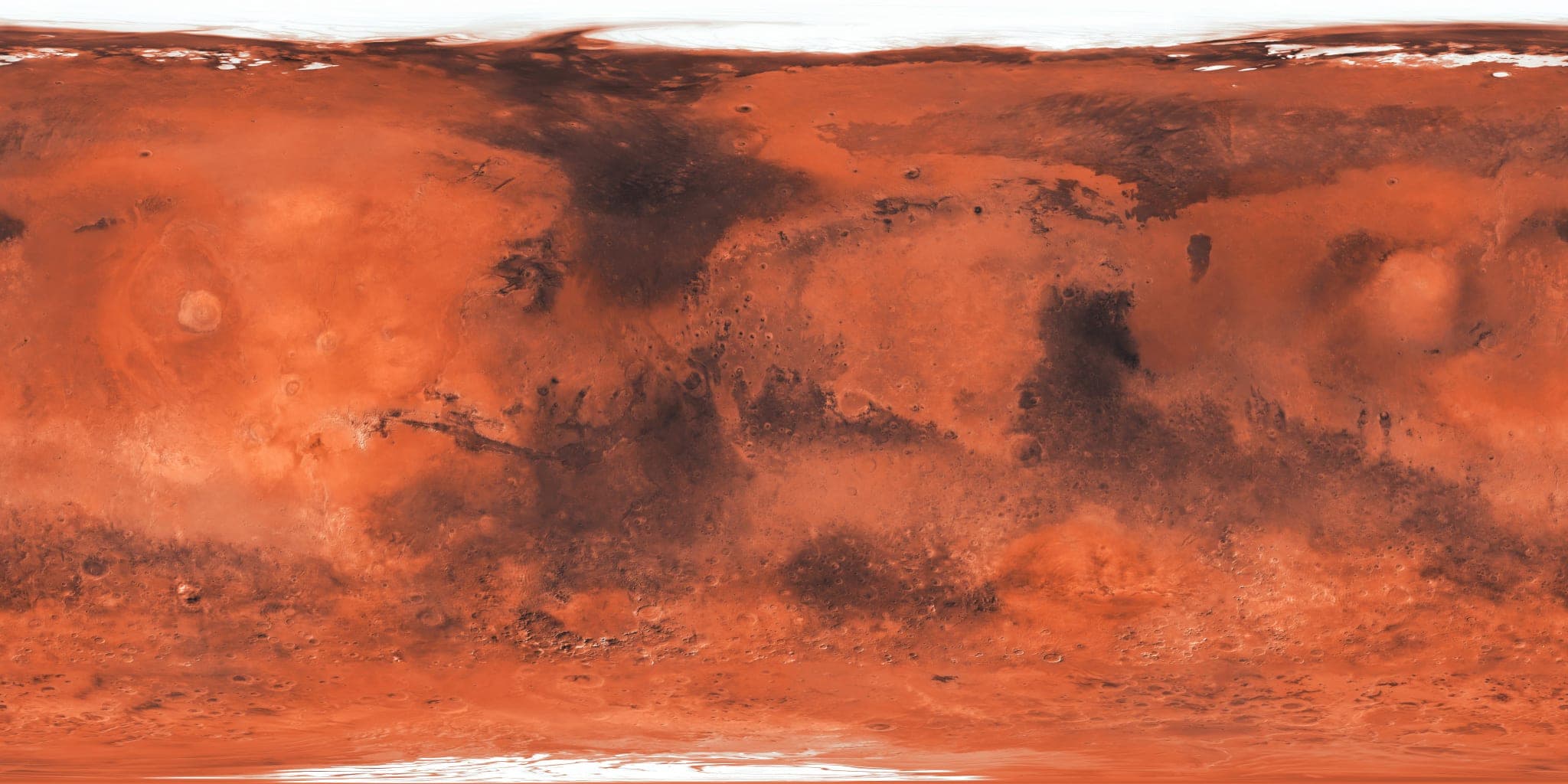
Martian rocks and soil contain many iron-bearing minerals. These minerals oxidized, much as iron rusts on Earth, and then broke into fine dust that spread across much of the surface. Winds lift the dust into the atmosphere, making the whole planet look red from far away.
Up close, the surface is not just one shade of red. Brown and golden soil, dark rocks, and pale minerals appear as well. “The Red Planet” does not mean every patch of ground has the same color; it means oxidized iron dust creates the planet’s most noticeable color from a distance.
What does Jezero’s dry delta show us?
A fan-shaped delta remains inside Jezero Crater, where the Perseverance rover is exploring. More than 3.5 billion years ago, a river crossed a gap in the crater wall, formed a lake, and deposited sand and mud. Orbital observations have also identified clay and carbonate minerals in the delta deposits that were altered by water.
A delta forms when a river slows as it enters a lake and drops the material it has been carrying. The layers photographed by Perseverance record not only a relatively calm lake but also later floods strong enough to move large boulders. Jezero’s water history was not a simple story of a lake filling once and then quietly drying up.
- A river cut a path Flowing water passed through an opening in the crater wall and carried sand and mud.
- A lake and delta formed As the water slowed, the material it carried settled in layers.
- Powerful floods followed Later torrents moved even large boulders toward the delta.
- The lake dried up The water disappeared after the climate changed, but the landforms and rock layers remained.
- A rover reads the record Perseverance studies the rocks with cameras and instruments and has sealed some samples.
When river-shaped valleys, a fan-shaped delta, and water-altered minerals connect at the same place, the history of an ancient lake comes into view.
Where did the water and thick atmosphere go?
Mars’s atmosphere is now far thinner than Earth’s, so liquid water cannot remain on the surface for long. But the water has not vanished completely. Ice exists at the poles and beneath shallow ground, and some water is locked inside the minerals that make up rocks.
A model of the Martian water cycle published in 2021 suggested that about 30–99% of the planet’s early water may have become trapped in crustal minerals. The very wide range shows that the exact amount is still uncertain. Some Martian water escaped to space, but it did not all disappear by the same route.
Much of the atmosphere escaped to space. From 2014 to 2025, the MAVEN orbiter observed how solar ultraviolet radiation and the solar wind strip particles from Mars’s upper atmosphere. An analysis based on the proportions of argon atoms estimated that about 65% of the argon once in the Martian atmosphere was lost to space. This result shows that the Sun played a major role in thinning the atmosphere over long periods.
Does a “potential biosignature” mean life was found?
No. A sample collected by Perseverance in 2024 from the rock called “Cheyava Falls” contains organic carbon-bearing mudstone and small spots where iron- and sulfur-rich minerals occur together. A 2025 Nature paper classified this combination as a potential biosignature because it could be consistent with biological activity.
A potential biosignature does not mean that life has been confirmed. It means scientists must test both the possibility that living things produced the feature and the possibility that chemistry without life produced it. Organic matter alone is not proof of life either.
The researchers examined several reactions that do not involve life, but the rover’s current instruments cannot determine which explanation is correct. Perseverance has sealed and stored a sample from this rock. More sensitive analyses and further research are needed to work out how the minerals, organic material, and spots formed.
The red desert preserves several kinds of evidence
Mars’s red dust reflects its dry environment today, while the valleys, deltas, and minerals beneath it record a wetter past. At Jezero, a calm lake and powerful floods left different rock layers, and neither the atmosphere nor the water disappeared through only one process.
That is why the history of Mars cannot be decided from a single photograph or one unusual mineral. When the shapes of landforms, the order of rock layers, mineral chemistry, and the proportions of atoms in the atmosphere agree, the planet’s changes become clearer. Mars is a dry desert, but it is also a planet that preserves a record of ancient environmental change.
Sources
- NASA Science — Mars Facts
- NASA Science — Mars 2020: Perseverance Rover
- NASA Science — Perseverance Science Highlights
- NASA JPL — New Study Challenges Long-Held Theory of Mars’ Water
- NASA Science — MAVEN
- NASA — Perseverance Potential Biosignature
- Nature — Redox-Driven Mineral and Organic Associations in Jezero Crater