What does “Earth-like” actually mean?
We can rarely see the surface of a distant exoplanet in detail. Instead, astronomers measure the starlight blocked when a planet passes in front of its star and the star’s motion under the planet’s gravity. Those measurements reveal the planet’s size and mass, letting us compare it with Earth one trait at a time.
“Earth-like” can refer to several different things: size, mass, incoming starlight, or atmosphere. A planet can be about Earth’s size and still have a very different surface. Being in the habitable zone does not prove that water or life is present. Astronomers measure each property separately to show exactly how the planet resembles Earth—and how it does not.
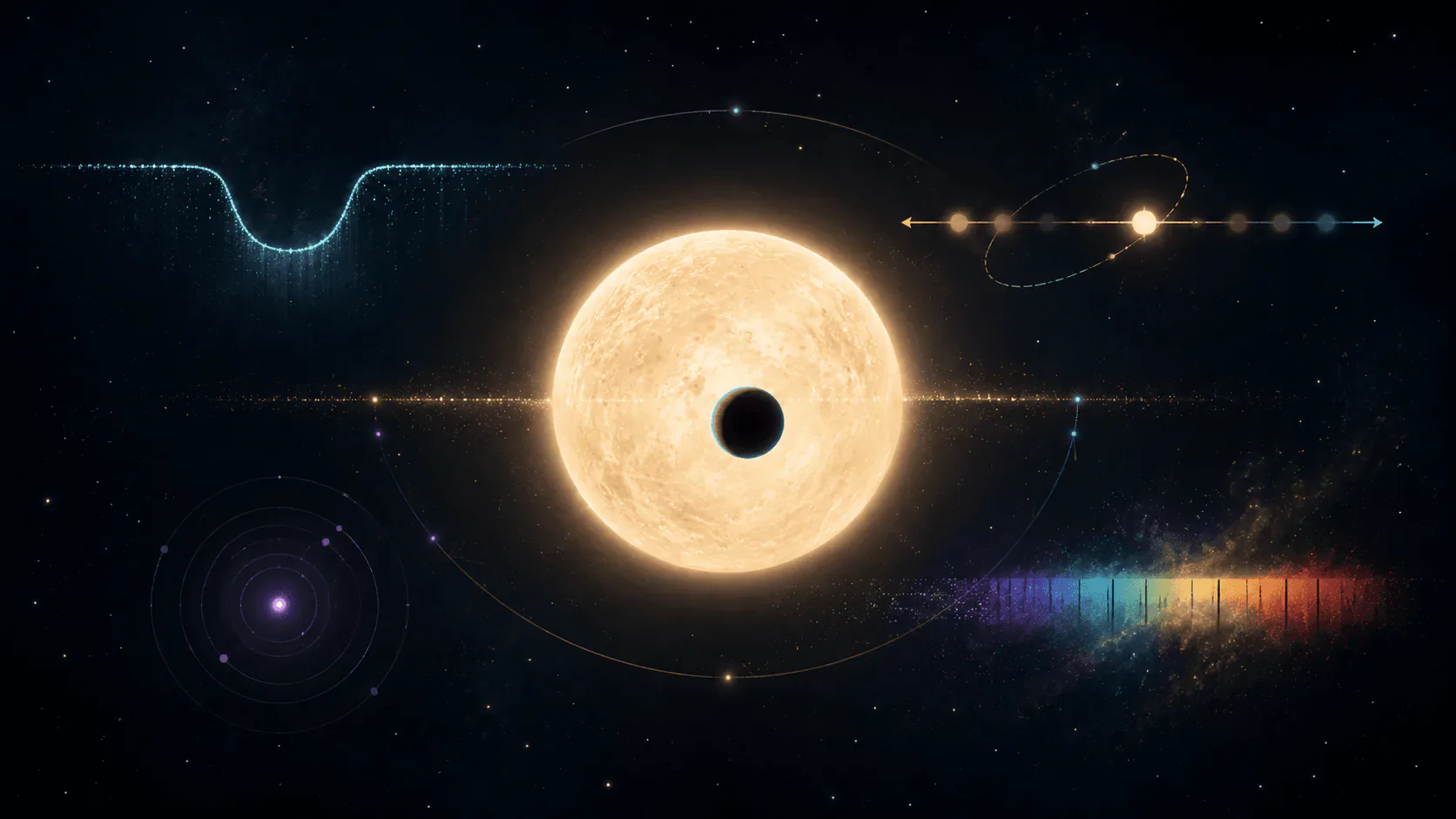
A dip in starlight reveals the planet’s size
When a planet passes in front of its star, it blocks some of the star’s light. Recording the star’s brightness over time produces a light curve with a dip in the middle. This is called a transit observation. If the dip repeats at regular intervals, it also reveals the planet’s orbital period.
The depth of the dip gives the ratio between the sizes of the planet and the star. A larger planet blocks more light and produces a deeper dip. But the planet’s actual size does not come from the transit alone. Astronomers must also know the star’s radius before they can calculate the planet’s radius.
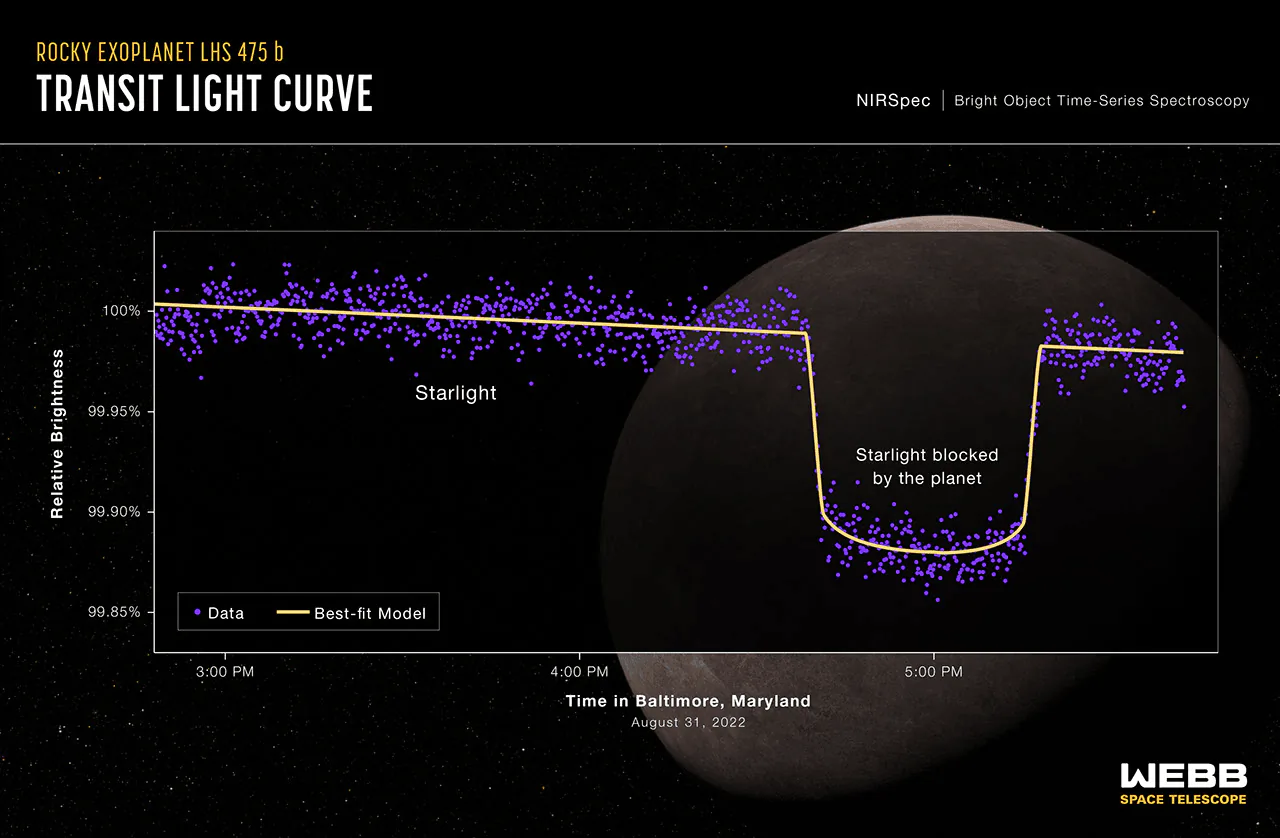
Not every planet crosses its star from our point of view. The transit method finds only planets whose orbits are aligned so that they block starlight. The planets found this way therefore do not represent the full population of planets.
A star’s wobble reveals the planet’s mass
A planet also exerts a small gravitational pull on its star. As the star moves toward us, absorption lines in its spectrum shift slightly toward blue; as it moves away, they shift toward red. This is called a radial-velocity observation. A repeating shift shows how strongly the planet is tugging on the star.
The size of the wobble depends on both the planet’s mass and the tilt of its orbit. For a planet that does not transit, the orbital tilt is not known precisely, so astronomers usually calculate a “minimum mass.” Starspots and flares can also change patterns in starlight, so stellar activity must be separated from the planet’s signal.
Radius and mass give the average density
A radius from transit observations can be combined with a mass from radial velocity or from shifts in the transit times caused by neighboring planets. Together, they give the planet’s average density. Density is an initial clue to whether a planet is mostly solid material or has a large layer of light gas.
Different interiors can produce the same average density. A rocky planet with less iron and a planet rich in water or other light materials can have similar densities. Other observations and models are needed to work out whether it has oceans or continents, or how large its core might be.
The habitable zone is calculated from starlight and atmosphere models
The habitable zone is the region around a star where liquid water could exist on a planet’s surface, assuming a suitable atmosphere. Astronomers calculate it by putting the star’s output, the planet’s orbit, and the atmosphere’s greenhouse effect into climate models. The region changes depending on whether the star is hot and bright or cool and faint.
A planet’s location in this region is not evidence that water, an atmosphere, or life has been found. Two planets receiving similar amounts of starlight can have very different surfaces because their atmospheres differ in thickness and composition. Those atmospheric properties, the star’s flares, and the presence of water must each be observed separately.
A transmission spectrum probes the atmosphere
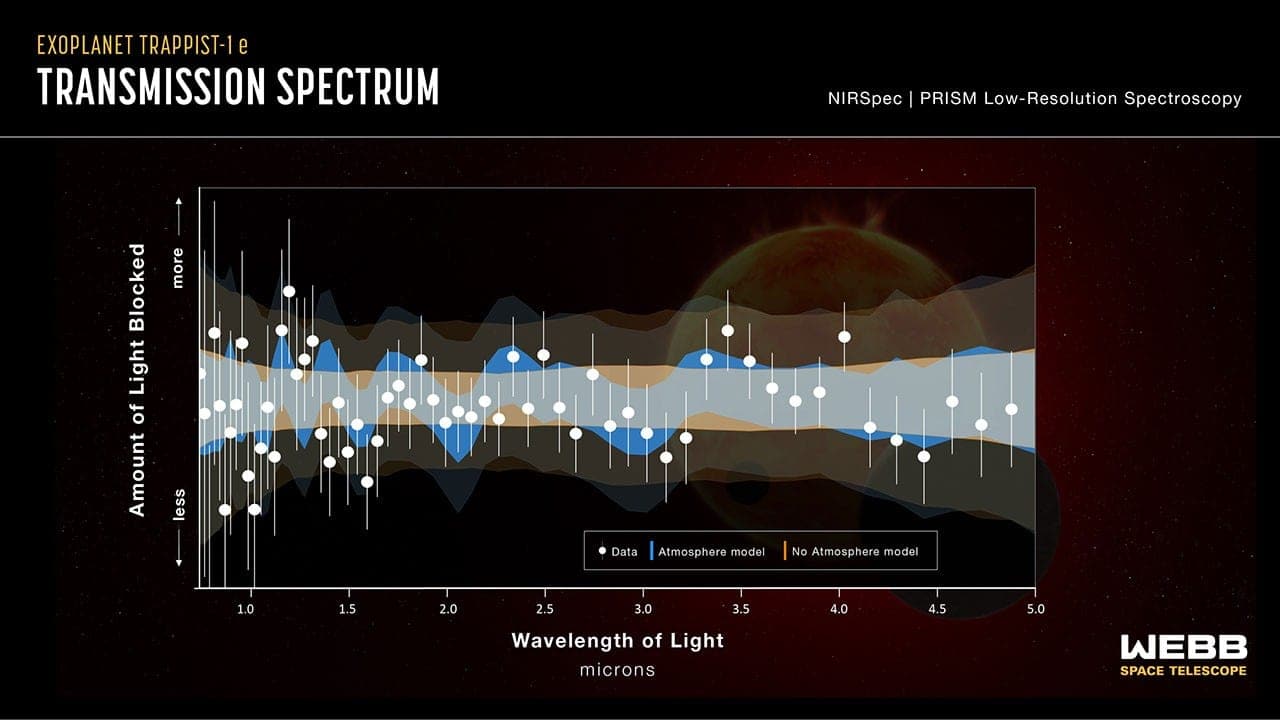
When a planet crosses its star, some starlight passes through the planet’s atmosphere. Materials in the atmosphere absorb particular wavelengths more strongly, making the planet appear very slightly larger at those wavelengths. Astronomers arrange the transit depths by wavelength into a transmission spectrum and compare it with different atmospheric models.
Every measurement has a range of uncertainty, and different atmospheric models can fit the same data. Starspots or bright regions on the part of the star crossed by the planet can also alter the transit depth at each wavelength. A small bend in a spectrum is therefore not enough to confirm a particular molecule—or life.
What observations tell us about TRAPPIST-1 e and Proxima Centauri b
-
TRAPPIST-1 e
TRAPPIST-1 e transits its star. Its radius is about 0.92 times Earth’s, and its mass was measured from changes in transit timing as neighboring planets tug on one another. Its average density is consistent with a rocky planet, but the data do not point to a single interior composition.
James Webb Space Telescope observations reported in 2025 do not fit a thick atmosphere dominated by hydrogen. But they still cannot distinguish between no atmosphere and several other possibilities, including a nitrogen-rich atmosphere. For now, the observations rule out some atmospheric models rather than identify one answer.
-
Proxima Centauri b
Proxima Centauri b orbits the nearest star about once every 11.2 days. Radial-velocity measurements give it a minimum mass about 1.07 times Earth’s. It is calculated to receive about 0.64 times the starlight Earth receives from the Sun.
No transit of this planet has been confirmed, so its actual radius and average density remain unknown. A calculated position in the habitable zone tells us nothing by itself about surface water or an atmosphere. Researchers must also investigate how flares from its active red-dwarf star affect the planet’s environment.
The easiest planets to detect are found first
The transit method favors large planets that block more starlight and close-in planets that transit often. Radial velocity is more sensitive to massive, short-period planets that pull their stars more strongly. Small planets on distant orbits produce weaker signals and take longer to confirm.
Current planet catalogs therefore contain a larger share of worlds that are easy to observe. To estimate how common planets really are, astronomers must account for detection probability and for the planets their surveys missed.
A planet’s radius, mass, incoming starlight, and atmosphere come from different observations. More data can narrow the possible explanations, but they cannot justify claims about an unobserved surface or life.
Sources
- NASA Science — How exoplanets are found and characterized
- NASA Science — Meaning and limits of the habitable zone
- ESA CHEOPS — The relationship among radius, mass, and average density
- ESA Ariel — Studying atmospheres with transmission spectra
- NASA Exoplanet Archive — Current parameters for TRAPPIST-1 e
- Agol et al. — Transit timing, masses, and radii of the TRAPPIST-1 planets
- Espinoza et al. — JWST transmission spectrum of TRAPPIST-1 e
- Glidden et al. — Current constraints on atmospheric models for TRAPPIST-1 e
- NASA Exoplanet Archive — Current parameters for Proxima Centauri b
- Faria et al. — Precision radial-velocity observations of Proxima Centauri
- Kipping and Sandford — Selection bias in transit surveys
- Rackham et al. — How stellar surfaces affect transmission spectra