Start with a few bright stars in the city
To find constellations in a city, begin with a shape made by two or three bright stars. Set your location, date, and time, then choose a bright pattern high in the sky viewer. Find the same spacing and tilt in the real sky, and work outward to the surrounding stars.

You do not need to name every star from the start. Once the arrangement of a few bright stars matches the screen, the constellations around them become much easier to find.
Set your location, date, and time first
The Big Dipper, Polaris, and the Summer Triangle often appear in Northern Hemisphere guides, but they are not visible at the same season or height everywhere. The Southern Hemisphere has opposite seasons at the same time of year, while temperate-season names are less useful near the equator.
Enter your location, date, and local time in the sky viewer, then choose one bright star pattern high in the sky. Objects near the horizon are easily blocked by buildings, mountains, and trees, so avoid them at first.
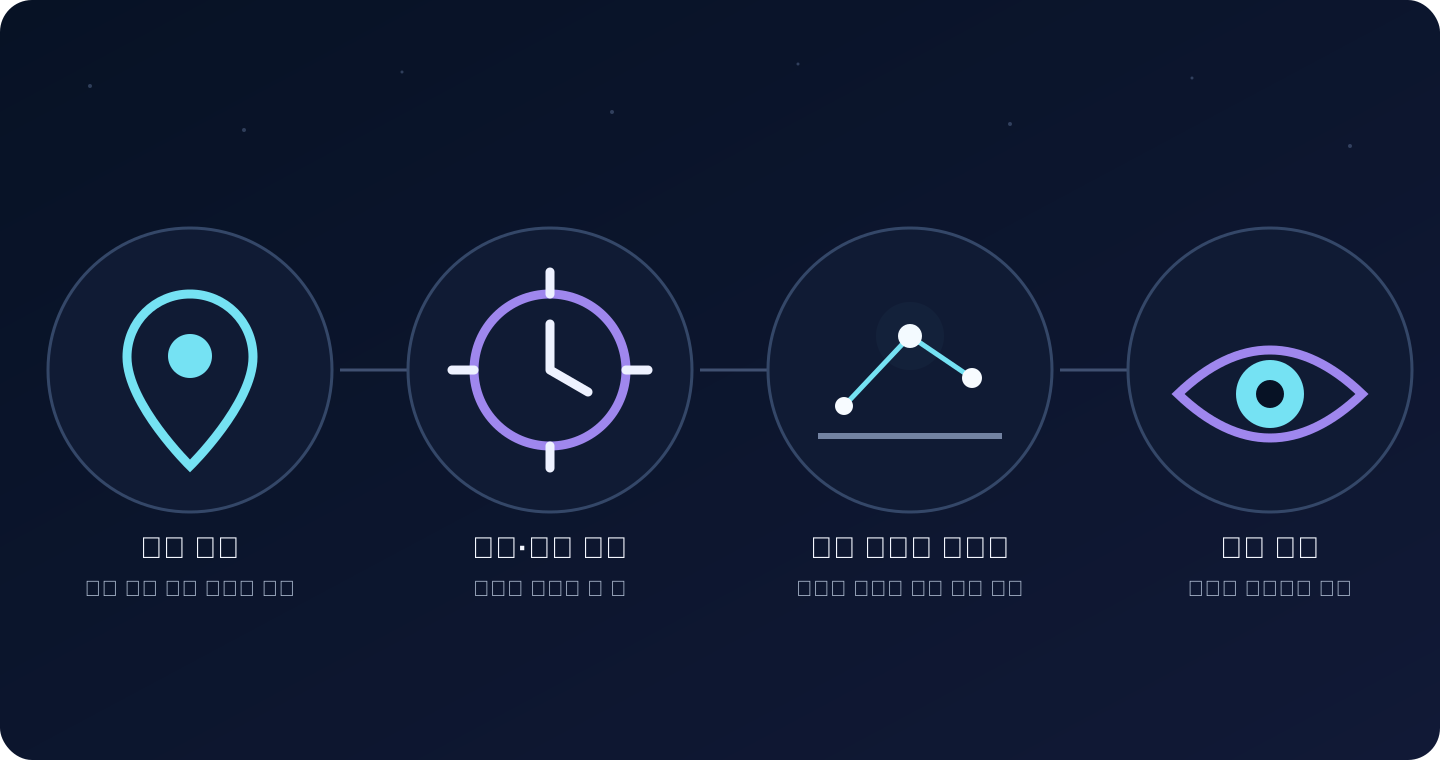
- Set the location. Use your current position or choose the city where you plan to observe.
- Set the date and local time. Preview the sky for when you will actually go outside.
- Choose a high target. A large shape made by two or three bright stars is easier to find.
- Check direction and altitude. Use the north, south, or zenith view to identify the part of the sky.
- Compare it with the real sky. Lower your phone and match the spacing and tilt between the stars.
Find a safe place with a wide view of the sky
Even among streetlights and signs, moving a short distance can change which stars are visible. Choose a safe place away from traffic where buildings and trees do not block much of the sky. Keep bright lights out of your direct view by using your body or a wall as a shield.
Check the sky viewer before going outside, and turn your phone brightness all the way down once you are there. Avoiding strong light for about 20 minutes helps your eyes adjust to the dark. A red screen can still be distracting when it is too bright, so lower brightness before changing screen color.
Direction guides differ by region
-
Where the northern sky is visible
Polaris is a useful guide to north. Draw a line through the two outer stars of the Big Dipper’s bowl and extend it toward Polaris. The closer you are to the equator, the lower Polaris appears above the horizon; it is not visible from the Southern Hemisphere.
-
Near the equator
Both celestial poles lie close to the horizon. Instead of starting with a pole star, check direction with the sky viewer or a compass and choose a bright pattern high overhead.
-
Where the southern sky is visible
There is no bright star like Polaris near the south celestial pole. The long axis of the Southern Cross points toward the pole, and the two bright Pointer stars in Centaurus help locate the Cross. These stars may also be out of view at some locations and times.
You do not have to find north first For a first target, height and brightness matter more than compass direction. If the viewer shows a clear star pattern in the south or overhead, begin there.
The “Summer Triangle” appears in different seasons around the world
Some star patterns, such as the Summer Triangle, include a season in their name. That season reflects the region where the name became common. Seasons are opposite across the hemispheres, and tropical regions do not have the same distinct four-season cycle. Check whether the pattern is visible now in the sky viewer instead of relying on its name.
Even widely visible patterns such as Orion’s Belt rise at different times depending on the date and hour. From the Southern Hemisphere, their tilt and orientation can differ from diagrams made for the north. Do not memorize left and right on a screen; match the shape formed by the horizon and the stars.
The Big Dipper, the Summer Triangle, and Orion’s Belt are asterisms: recognizable patterns of bright stars. In astronomy, constellations are the 88 regions that divide the entire sky. One asterism does not necessarily match one constellation.
Look back and forth between the viewer and the sky
Set the location, date, and time in the viewer, then check the target’s direction and height above the horizon. Outside, avoid staring at the screen for too long and compare the spacing and tilt of stars in the real sky.
The viewer calculates where celestial objects should be. Whether you can see them depends on daylight or twilight, clouds and haze, moonlight, buildings, and nearby lighting. If a correctly placed target is still hidden, switch to a brighter one higher in the sky.
Match a pattern, not one point A single exceptionally bright point may be a planet such as Venus or Jupiter. Check the spacing and shape made with two or three nearby stars as well.
If you cannot see it, check these in order
- Location: Make sure the viewer has not selected a different city.
- Date and time: Check whether the target has not risen yet or has already moved low.
- Direction: Make sure you have not reversed north and south, or east and west.
- Horizon: See whether buildings, mountains, or trees block the lower sky.
- Sky conditions: Check whether clouds, haze, a bright Moon, or nearby lights hide faint stars.
Finding one large pattern is enough for your first night. Find it again on your next outing, then add the surrounding stars one by one.
Sources
- NASA, Skywatching Frequently Asked Questions
- NASA, How to Find Good Places to Stargaze
- NASA, What Are Asterisms?
- NASA, What Is the North Star and How Do You Find It?
- IAU astroEDU, What Is a Constellation?
- IAU astroEDU, Navigation in the Ancient Mediterranean and Beyond
- ESO, Under the Southern Cross
- U.S. Naval Observatory, Altitude and Azimuth
- U.S. National Park Service, Dark Adaptation of the Human Eye