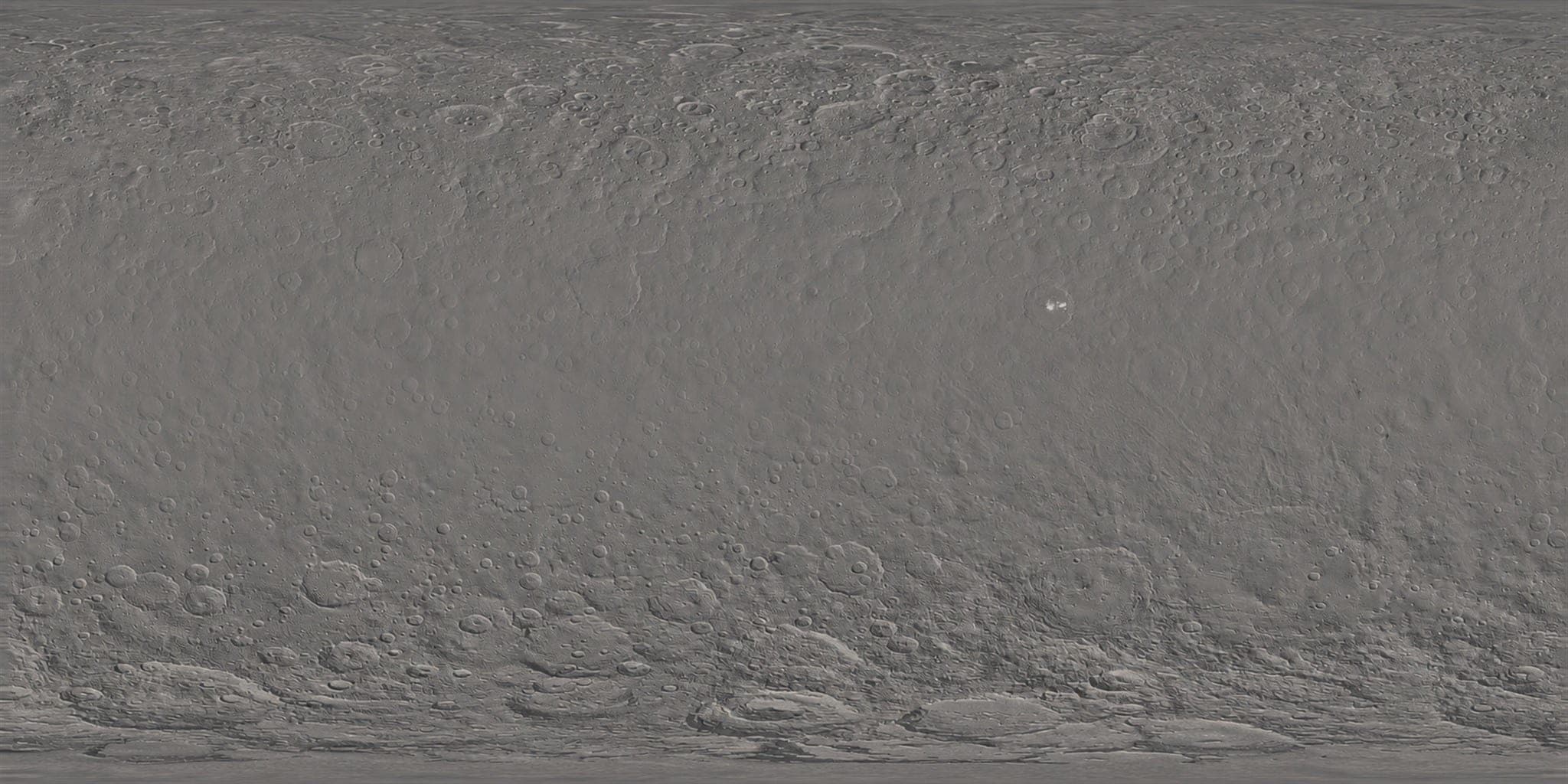
What are Ceres’s bright spots made of?
The bright spots on Ceres are not pure ice but deposits rich in salt. Briny water rose from below the surface through fractures; as the water froze or escaped as vapor, bright salts were left behind. By measuring the spots’ composition and Ceres’s gravity, NASA’s Dawn spacecraft found clues that water persisted inside Ceres for a long time.
When Dawn approached Ceres in 2015, spots inside Occator Crater stood out against the dark surface. What had looked like a single patch of light from far away separated into many deposits in close-up images. A spectrometer, which identifies materials from the light they reflect, detected sodium carbonate and several other salts. Some of these deposits are interpreted as having formed relatively recently on a geological timescale.
- About 940 km across the distance from one side of Ceres to the other
- Largest in the asteroid belt the biggest object between Mars and Jupiter
- About 25% of its mass the estimated share of Ceres’s interior made up of ice
- About 40 km underground the estimated depth of a brine reservoir beneath Occator Crater
Why is Ceres both an asteroid and a dwarf planet?
When Giuseppe Piazzi discovered Ceres in 1801, it was called a planet. After more small bodies were found in similar orbits, Ceres was grouped with the asteroids. In 2006, its nearly round shape and planet-like internal evolution led to its classification as a dwarf planet. “Asteroid-belt object” describes where Ceres is, while “dwarf planet” describes its shape and orbital status, so both labels can be correct.
Dawn first orbited Vesta, then used ion propulsion to change course and reach Ceres. The two large bodies in the same asteroid belt had very different histories. Vesta is dry and resembles a protoplanet whose rock and metal separated into layers, while Ceres is less dense and rich in hydrated minerals, ice, and salts. Their differences show that bodies in the same asteroid belt can begin with different materials and follow very different paths of change.
The bright salt deposits are not a photograph of an underground ocean. They are chemical traces showing that briny water moved through fractures below the surface.
How did briny water beneath the crater reach the surface?
Occator Crater is about 92 km wide. The impact fractured the crust and supplied heat for a time. A 2020 study combining Dawn’s gravity data, topography, high-resolution images, and thermal models concluded that impact-made fractures connected the surface to a deep reservoir of brine. The estimate of a broad reservoir about 40 km below the surface comes from an internal model that fits all these observations, not from a direct image.
At first, it seemed possible that the bright material came only from shallow ice melted by the impact. However, the distribution and ages of Cerealia Facula at the center and the surrounding Vinalia Faculae required a longer-lasting supply. The interpretation that deep brine continued moving through fractures after the impact heat faded shows that a small body can remain geologically active longer than expected.
A “deep brine reservoir” does not mean that a liquid ocean surrounding all of Ceres has been confirmed today. It is a regional remnant of liquid inferred from gravity and thermal evolution; its exact extent and present state remain questions for a future mission.
Do water and organic matter mean that life existed?
Dawn’s infrared spectrometer detected signs of aliphatic organic matter—molecules built from chains of carbon and hydrogen—near Ernutet Crater. Finding hydrated minerals, carbonates, ice, and organic matter on one world gives scientists a rare opportunity to study chemical reactions between water and rock. But organic molecules can also form in meteorites and through non-biological chemistry. Dawn could not determine whether the material had a biological origin, and it did not detect life.
A NASA-supported thermal and chemical model published in 2025 calculated that altered rock inside ancient Ceres may have supplied its brine with molecules such as carbon dioxide and methane. Such molecules could provide chemical energy for microbial metabolism. The result suggests that “food” may once have been available, not that organisms were there to consume it. Water, organic matter, and energy are ingredients of habitability, not proof of life.
- 1801 — Discovery Piazzi first reports Ceres as a planet; as the asteroid belt’s known population grows, it is reclassified as an asteroid.
- 2006 — Dwarf planet Ceres enters the dwarf-planet category: its gravity makes it round, but it does not dominate its surrounding orbit.
- 2015 — First orbiter Dawn becomes the first spacecraft to orbit a dwarf planet and maps Ceres in images, gravity, elements, and minerals.
- 2018 — Mission ends Dawn runs out of fuel for attitude control but remains in orbit around Ceres, leaving its collected data intact.
- Since 2020 — Reading the data again Gravity, thermal, and chemical models test ideas about deep brine and ancient energy sources.
What should a future mission investigate?
Dawn used cameras and several analytical instruments to survey Ceres’s terrain and composition, but it could not analyze the bright salts directly. A future mission should map in greater detail the deposits that formed relatively recently in Occator Crater, measure the isotopes and molecular structures of organic matter and salts on site, or return samples to Earth. These measurements could reveal how long the brine remained liquid and whether the organic matter formed inside Ceres or arrived on an impactor.
Ceres is fascinating not because we can claim that an Earth-like ocean lies hidden there today. Rather, water and rock could interact for a long time even inside a small body, and fractures made by an impact carried material from the interior to the surface. The bright salt deposits show that Ceres is not simply a completely frozen rock, but a dwarf planet that preserves evidence of water and internal change.
Sources
- NASA Science — Ceres Facts
- NASA Science — Dawn Science: Ceres
- NASA/JPL — Bright Areas Come From Salty Water Below
- NASA NTRS — Impact-driven Mobilization of Deep Crustal Brines
- NASA/JPL — Evidence for Organic Material on Ceres
- NASA Science — Dawn Mission Highlights
- NASA/JPL — Long-Standing Energy and Ancient Habitability