Why does methane, rather than water, fall as rain on Titan?
In Titan’s sky, methane forms clouds and falls as rain. The liquid runs through valleys, collects in lakes and seas, and eventually evaporates again. The cycle resembles Earth’s water cycle, but at Titan’s surface temperature of about −179°C, water forms a solid ice crust while methane and ethane can move as liquids.
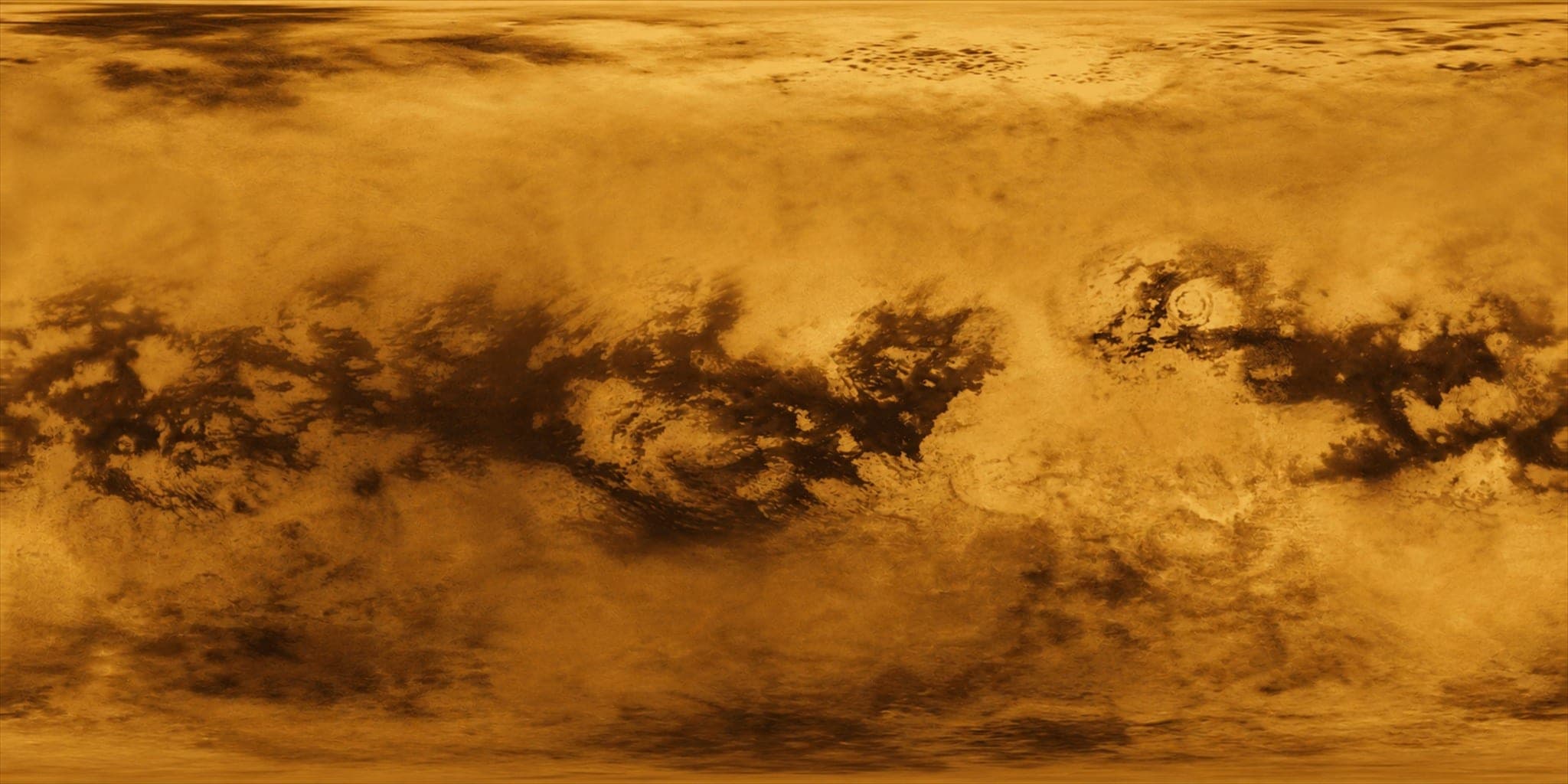
Thick haze makes the surface difficult to see in visible-light images. The Cassini spacecraft sent out radio waves and measured their echoes to map lakes and seas near the north pole, long equatorial dunes, and branching valleys across the moon. Titan’s landscape may look familiar, but its ground and liquids are made of very different materials.
- About 5,150 km in diameter Titan’s width measured from one side to the other
- About −179°C Titan’s average surface temperature
- About 1.6 times Earth’s Atmospheric pressure measured at Titan’s surface
- About 95% nitrogen An atmosphere with about 5% methane and traces of other gases
Methane flowing over a water-ice crust
Methane evaporates from lakes and damp ground, cools in the atmosphere, and forms clouds. Methane rain cuts channels into the icy crust and flows downhill into lakes and seas. A single season on Titan lasts about seven and a half Earth years. As the seasons change, the regions where clouds and rain are concentrated also shift slowly over many years.
Not every lake and sea has the same depth or composition. Analysis of data from Cassini’s final close flyby of Titan found that some small northern lakes are more than 100 metres deep and filled mostly with methane. In the southern hemisphere’s Ontario Lacus, methane and ethane were measured in roughly similar proportions. The balance differs from place to place because evaporation and seepage into the ground do not occur at the same rates everywhere.
How do haze and sand form in the sky?
High in the atmosphere, sunlight and energetic particles from Saturn’s surroundings break apart methane and nitrogen molecules. The fragments recombine into larger, more complex carbon compounds. Lighter particles remain suspended as a dense haze, while material that grows heavier settles to the surface and contributes to the broad equatorial dunes.
These reactions steadily consume methane in the atmosphere, yet Titan still has methane clouds and lakes today. Scientists have not determined whether methane rises from the interior, leaks from reservoirs in the crust, or is supplied by both processes. The abundance of complex organic compounds is not evidence by itself that life exists there. Sunlight and atmospheric chemistry can produce them without life.
Titan does not resemble Earth because it is made of the same substances. The resemblance lies in a cycle where liquid evaporates, falls as rain, erodes the ground, and gathers again in lakes and seas.
Did water flow through the riverbeds Huygens saw?
On 14 January 2005, the European Space Agency’s Huygens probe descended by parachute through Titan’s atmosphere for about two and a half hours. Beneath the haze it revealed branching valleys and a dark plain, then landed on soft ground scattered with rounded pieces of ice. At Titan’s temperature, water ice is as hard as rock, so these pieces can retain shapes like river pebbles on Earth.
Huygens did not see a flowing river or falling rain at the moment it landed. The shape of the valleys, the rounded and worn ice pieces, and methane detected at the landing site support the interpretation that liquid had flowed there in the past. Evidence from this one location, combined with Cassini’s long-term global mapping, became part of the case for Titan’s methane cycle.
Is there an ocean beneath the ice crust?
As Cassini passed close to Titan, Saturn’s gravity stretched and compressed the moon slightly. The spacecraft’s speed changed by a tiny amount, shifting the frequency of radio signals exchanged with Earth. Early analyses explained Titan’s large deformation as evidence for a global water ocean beneath the ice.
In 2025, researchers reduced the noise in the same radio data and analysed it again. They found signs that Titan’s deformation lagged several hours behind Saturn’s pull and that considerable energy was lost to friction inside the moon. The team proposed that the signal may be better explained not by one continuous liquid ocean, but by a layer containing some water among high-pressure ice close to melting, together with small pockets of water near the rocky core.
This result is not a confirmed cross-section of Titan’s interior. It is a new model that best fits the Cassini data and still needs to be tested with other observations and experiments. The methane seas at the surface and the possible water deep inside are separate environments divided by a thick layer of ice.
Why will Dragonfly fly instead of staying in one place?
Titan’s gravity is much weaker than Earth’s and its atmosphere is denser, making flight with rotors comparatively easy. NASA’s Dragonfly is a nuclear-battery-powered spacecraft designed to land at several sites and measure the composition of the ground and atmosphere. Its mission is not to visit the northern seas. It will begin among the equatorial dunes, examine different organic-rich terrains, and travel toward the area around Selk crater.
As of August 2026, Dragonfly is in the assembly and testing phase. NASA’s current schedule targets a launch no earlier than July 2028 and arrival in late 2034. The mission is not intended to announce the direct discovery of life. It will investigate what chemical reactions occurred when atmospheric organic material met ice and water that had once melted, and what conditions Titan may offer for prebiotic chemistry.
Familiar landscapes made from very different materials
Beneath Titan’s hazy atmosphere are rain-cut valleys, lakes, seas, and dunes. But the solid ground is water ice, while the liquid moving between the sky and surface is mainly methane. Titan resembles Earth not in colour or composition, but in the way circulating liquid reshapes the landscape.
Huygens directly examined ice pebbles and soil at one site, while Cassini surveyed the surface beyond the haze and measured broad gravitational signals from the interior. Dragonfly will add samples and seismic measurements from several locations, helping connect these two scales of observation. Titan is not a copy of Earth: it shows that rain, rivers, and seas can form from entirely different materials under very different conditions.
Sources
- NASA Science — Titan Facts
- NASA Science — Cassini at Titan
- NASA Science — Cassini Reveals Surprises with Titan’s Lakes
- ESA — Highlights of the Huygens Mission
- NASA/JPL — Titan May Not Have a Global Ocean
- Nature — Titan’s Strong Tidal Dissipation
- NASA Science — Dragonfly
- NASA Science — Dragonfly Integration and Testing