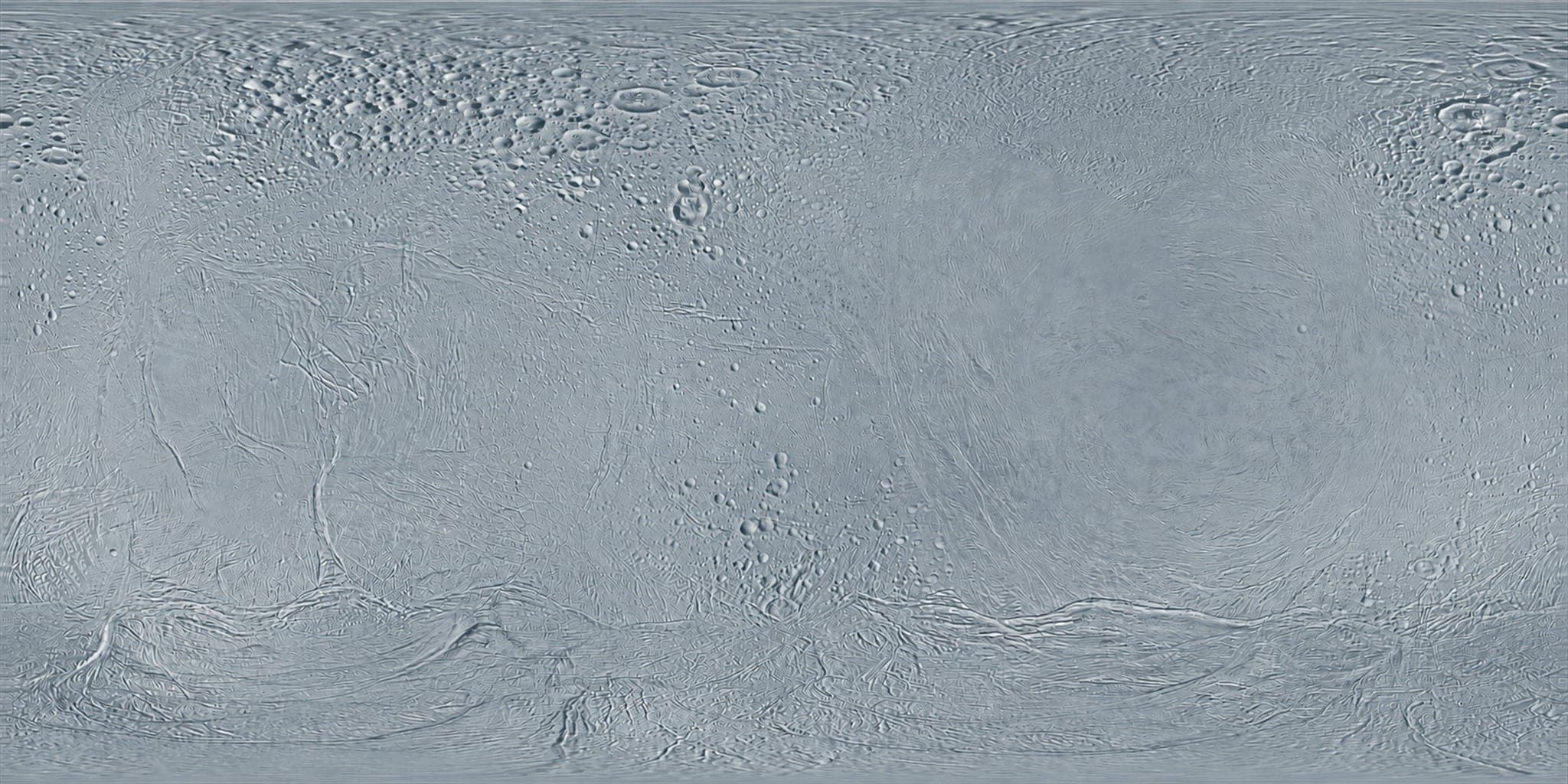
How does Enceladus’s ocean water reach space?
Four long fractures cut through the icy shell at Enceladus’s south pole. Water vapor and ice grains continually rise from these openings, carrying salts and organic compounds from the ocean below. By flying through the plume, the Cassini spacecraft analyzed material from the interior ocean without drilling through the ice.
Some of the expelled ice falls back onto Enceladus and forms a bright, clean layer on its surface. Grains that travel farther escape into orbit around Saturn and supply the broad, faint E ring. Both Enceladus’s brilliant surface and Saturn’s E ring are evidence that material is still rising from inside this small moon.
- About 500 km across The distance from one side of Enceladus to the other
- About 33 hours The time Enceladus takes to complete one orbit around Saturn
- About 20–25 km on average The global ice-shell thickness estimated by interior models
- About 1–5 km at the south pole The estimated minimum ice thickness in the plume source region
How do we know the ocean is not confined to the south pole?
When the plume was first discovered, it was reasonable to ask whether a small pocket of water beneath the south pole might be feeding it. As Cassini passed close to Enceladus, researchers measured tiny changes in the spacecraft’s speed to map how mass is distributed inside the moon. Images taken over several years also let them compare the positions of surface features and measure how far the moon rocks back and forth as it rotates.
If Enceladus’s icy shell were firmly attached to its rocky interior, it could not rock as much as observed. A liquid layer separating the shell from the rock is needed to explain the motion. A 2015 analysis supported the conclusion that this layer is not limited to the south pole but forms an ocean surrounding the whole moon.
Current interior models estimate an average ice-shell thickness of about 20–25 km and a thickness of about 1–5 km in the south-polar plume region. These figures were not measured by drilling. They are ranges calculated to account for the moon’s gravity, surface motion, and shape together.
What can ice grains tell us about the ocean floor?
Cassini found extremely small silica grains in the plume and the E ring. Experiments show that grains like these can form when liquid water reacts with rock at temperatures of about 90°C or higher. They must then travel from the ocean to space before growing much larger in order to retain the small sizes that Cassini observed. The result indicates that warm water may still be reacting with rock on the ocean floor.
Molecular hydrogen was also detected in the plume. Reactions between water and rock can produce hydrogen, and some microorganisms on Earth use it as an energy source. Cassini did not photograph hydrothermal vents on Enceladus, however. The point is that reactions between warm water and rock provide the most persuasive explanation that fits both the silica and hydrogen evidence.
Organic compounds and phosphates were found in salt-bearing ice grains as well. The phosphorus in phosphates is essential to DNA, cell membranes, and energy transfer in life on Earth. But organic compounds and phosphates can also form without life. Finding ingredients needed by life is clearly different from finding living organisms.
Cassini never saw Enceladus’s ocean directly. Instead, it measured salts, organic compounds, and signs of warm water reacting with rock inside ice grains that had risen from the ocean.
Does ice preserve ocean water unchanged after it reaches space?
The plume consists of material that traveled from the ocean through cracks in the ice. Along the way, some material can freeze onto the crack walls, while gases and ice can separate in different proportions. The observed plume therefore cannot be assumed to reproduce the composition of the entire ocean exactly. Once in space, the material is also exposed to vacuum and radiation. Grains that have spent a long time in the E ring may consequently differ from grains collected just after eruption.
In 2025, researchers reanalyzed ice grains Cassini had collected about 21 km above Enceladus’s surface. Because these grains had not spent a long time orbiting in the E ring, their composition was closer to that of material newly released from the ocean. The team identified a wider variety of organic compounds than before, supporting the conclusion that the complex organics found in the E ring were not produced solely by prolonged exposure to space.
Cassini’s instruments revealed the masses of molecules present, but they could not distinguish the exact structure of every molecule. “New organic compounds” are clues to active chemistry, not confirmation that biological metabolism produced them.
What should the next spacecraft investigate?
A spacecraft can collect interior material at Enceladus by flying through the plume rather than drilling through the ice. Repeated passes at different heights and times could compare components carried from the ocean with components altered during their journey through the cracks. A more precise mass spectrometer could determine molecular structures and isotope ratios, revealing more detail about the reaction pathways between water and rock.
Finding a single organic compound would not be enough to identify a sign of life. Researchers would need to test whether several molecules occur together in ratios and structures expected from metabolism, while also comparing nonbiological reactions that could produce the same result. Contamination checks would also be required to rule out material carried from Earth.
The bright ice surface is a trace of the ocean within
The white surface in images of Enceladus does not mark a snowball that froze long ago and has remained inactive ever since. It stays bright because ice from the south-polar fractures continually settles onto it. Saturn’s E ring is another outcome of the same plume: particles that escape the moon’s gravity spread around the planet.
The moon’s rocking motion and gravity revealed an ocean surrounding the entire body, while the composition of the expelled ice showed that this ocean interacts with rock. No life has been found, but Enceladus is a rare place where material from an interior environment containing liquid water and chemical energy can be measured directly in space.
Sources
- NASA Science — Enceladus
- NASA Science — Cassini at Enceladus
- NASA Science — Cassini Finds Global Ocean
- Icarus — Enceladus’s Libration Requires a Global Ocean
- Nature — Ongoing Hydrothermal Activity within Enceladus
- NASA/JPL — Phosphates in Enceladus’ Ocean
- Nature — Detection of Phosphates from Enceladus’ Ocean
- NASA — Organics Fresh From Enceladus’ Ocean